The insurance agent who wasn't. The emergency that never happened.
Michelle Acker pleaded guilty this week to a six-year wire fraud that drained more than $670,000 from an elderly woman and her friend. The mechanism was a voice on the phone, an emergency that never ended, and an insurance agent who never existed.
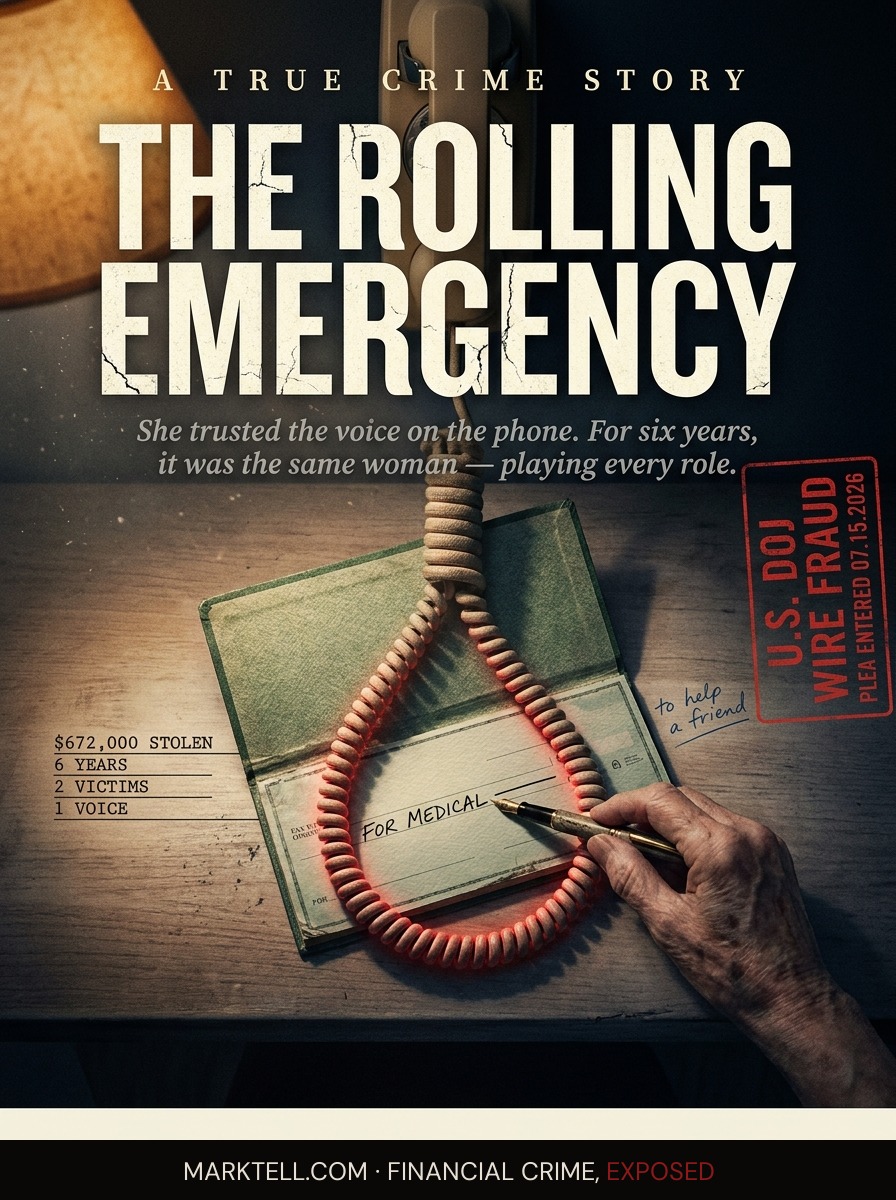
Ruth kept her checkbook in the drawer beside the kitchen phone. That was the geography of the crime. The phone on the wall, the drawer below it, the small round table where she sat down to write. Seventy-eight years old. A retired schoolteacher who had spent forty-one years telling other people's children how to sound out a word. She still wrote her sevens with a slash through the middle. She still balanced her register on the first of the month.
The first call came on an ordinary afternoon. The voice on the other end was one she knew. Something had happened. There was a bill. Could Ruth help.
Ruth could help.
She wrote the check at the table by the phone. She wrote the memo line the way a teacher writes a memo line. She put the check in an envelope. She walked it to the mailbox.
That was six years ago.
I.
The woman who took the money is named Michelle L. Acker. She is 51 years old. She lived in Westfield, Indiana, a suburb north of Indianapolis where the lawns are wide and the mailboxes match the houses. On Wednesday, July 15, 2026, she stood in a federal courtroom in Indianapolis and pleaded guilty to wire fraud. The Department of Justice put the loss at more than $670,000. The victims were an elderly woman and her friend. The scheme, according to the plea, ran six years.
Six years is what makes this a chapter and not a headline.
A one-time con is theft. A six-year con is a relationship. Six years is birthdays. Six years is Christmas cards. Six years is a voice on the phone that Ruth was glad to hear.
The mechanism has a name in the elder fraud literature, though the literature is polite about it. Call it the rolling emergency. The crisis that never resolves. A medical bill this month, a complication next month, a specialist the month after that. The story never ends because the story is the product. The moment the emergency ends, the payments end. So the emergency does not end.
According to the federal charging documents, Acker did two things at once. She fabricated the medical emergencies. And when it came time to be paid, she impersonated the insurance agents who were supposedly handling the case. One voice. Two masks. The victim who called for reassurance got the same person she had called for help.
That is the trapdoor. There was no second opinion available. Every door in the house opened into the same room.
II.
Picture it.
Ruth is at the table. The phone rings. The voice tells her the situation has gotten worse. The bill is larger this time. There is an insurance company that can help but the paperwork requires a payment upfront to release the claim.
Ruth writes the check.
A week later a different voice calls. This voice says she is with the insurance company. She has good news. The claim is moving. It just needs one more payment to clear a processing hold.
Ruth writes the check.
The federal record indicates both voices were the same woman. Prosecutors say Acker built the second character to close the loop the first character opened. The victim never had to leave her kitchen to verify anything, because the verifier was the perpetrator.
Now watch what six years does to a checkbook.
If a fraud collects $672,000 over six years, that is $112,000 a year. That is roughly $9,300 a month, though frauds like this do not run at a steady rate. They run in surges. A quiet month. Then three checks in a week. Then quiet. Then a crisis. The register fills up in bursts.
Ruth's friend was pulled in too. The DOJ materials describe an elderly victim and her friend. That detail matters. In elder fraud, the friend is often the second wallet. She trusts the first victim. The first victim trusts the voice. The voice reaches through one trusted person to the next.
That is how six years becomes $672,000.
III.
Indiana is not a small footnote in this story. Indiana is the story's backdrop, and the backdrop is loud.
In 2025, Indiana seniors reported $82 million in losses to the FBI from 4,199 victims. That is a 119 percent jump in dollars against a 21 percent drop in victims. Read that again. Fewer people are getting hit. The people who get hit are losing much more. The average loss per victim in Indiana roughly tripled.
The state ranks second in the nation for fraud complaints per capita among seniors. Over the past three years, elder fraud complaints in Indiana climbed 240 percent.
Ruth is not an anomaly. Ruth is a data point in a curve that keeps steepening.
The national number for 2023, per FBI and FTC reporting, was $4.8 billion lost by Americans 60 and older. That was two years before Ruth's case reached a plea. The curve since then has gone one direction.
The reader should sit with this. The scheme against Ruth was not exotic. It was not crypto. It was not romance. It was not a fake grandson in a jail cell needing bail. It was a voice she knew, a bill that needed paying, and an insurance agent who said the check would fix it.
Nothing about the mechanism required technology. It required a phone and a story and a woman willing to tell that story for six years.
IV.
The plea was entered on a Wednesday. Federal wire fraud carries a maximum sentence of 20 years. The court will set the number at sentencing. Restitution was ordered as part of the plea agreement, though the record has not yet been made public in full.
The paperwork is small. A charging document. A plea agreement. A signature. The paperwork does not describe Ruth's kitchen. It does not describe the table by the phone. It does not describe the drawer where she kept the checkbook.
That is what paperwork does. It compresses six years into a paragraph.
Here is what the paragraph leaves out.
Ruth had a friend. Ruth had a friend who trusted her enough to write her own checks into the same scheme. When the plea is unsealed and the story reaches the friend, someone has to have that conversation. Someone has to sit at a kitchen table across from another woman in her seventies and explain that the medical emergencies were not real, that the insurance agent was not an insurance agent, that the money is gone, and that the person on the phone all these years was the same person on the phone all these years.
That conversation is not in the DOJ press release.
That may be the saddest part.
V.
The pattern to remember.
Not the exciting questions. Not the television questions. The ugly questions.
When a caller asks for money for a bill, does verification of the bill require calling a number the caller provided? If yes, the loop is closed. The verifier and the perpetrator are the same room.
When a "crisis" continues past its natural resolution, is there always a new complication requiring one more payment? A real emergency ends. A rolling emergency is a subscription.
When the person asking is someone the victim already knows and trusts, is anyone else in the family aware of the ongoing payments? A fraud that runs six years is a fraud that runs in silence.
The machine does not need sophistication. It needs isolation, familiarity, and a story that never ends.
Ruth wrote her last check somewhere in year six. She did not know it was the last check. The last check is only visible in retrospect, in a federal filing signed in July 2026 by a woman in Westfield who is now looking at up to 20 years.
Ruth is still at the table. The phone still rings sometimes. She does not know yet which calls to trust.
She thought she was helping a friend.
She was the emergency.
- IndyStar | July 15-16, 2026 | "Westfield woman pleads guilty to $672k fraud targeting elderly"
- U.S. Department of Justice | July 15, 2026 | Guilty plea, U.S. v. Michelle L. Acker, Southern District of Indiana
- FBI Internet Crime Complaint Center (IC3) | 2025 Elder Fraud Report | Indiana state data, $82M in losses, 4,199 victims
- FBI/FTC | 2023 | Elder fraud national loss figure, $4.8B
Editorial Notice
MarkTell is a true crime publication about financial fraud. Some scenes, dialogue, and sequential details are reconstructed from court filings, enforcement actions, news reports, and public records. Where the public record does not provide exact details, editorial reconstruction is used to convey the documented pattern of events. Names of private individuals may be changed to protect identity. All factual claims are sourced to public documents cited in the Evidence Trail above. MarkTell does not provide investment, legal, or financial advice. Nothing published here constitutes a recommendation to buy, sell, or avoid any investment. Allegations described in active cases have not been adjudicated and defendants are presumed innocent until proven guilty. Readers should conduct their own due diligence before making financial decisions.