The house on the empty lot was built on a signature that never existed
Federal prosecutors say three men ran a multi-state scheme that hunted vacant, unencumbered properties, forged the owners into existence on paper, and sold the land to buyers who never knew the sellers were ghosts. One Concord family drove out to check on a lot and found a house sitting on it.
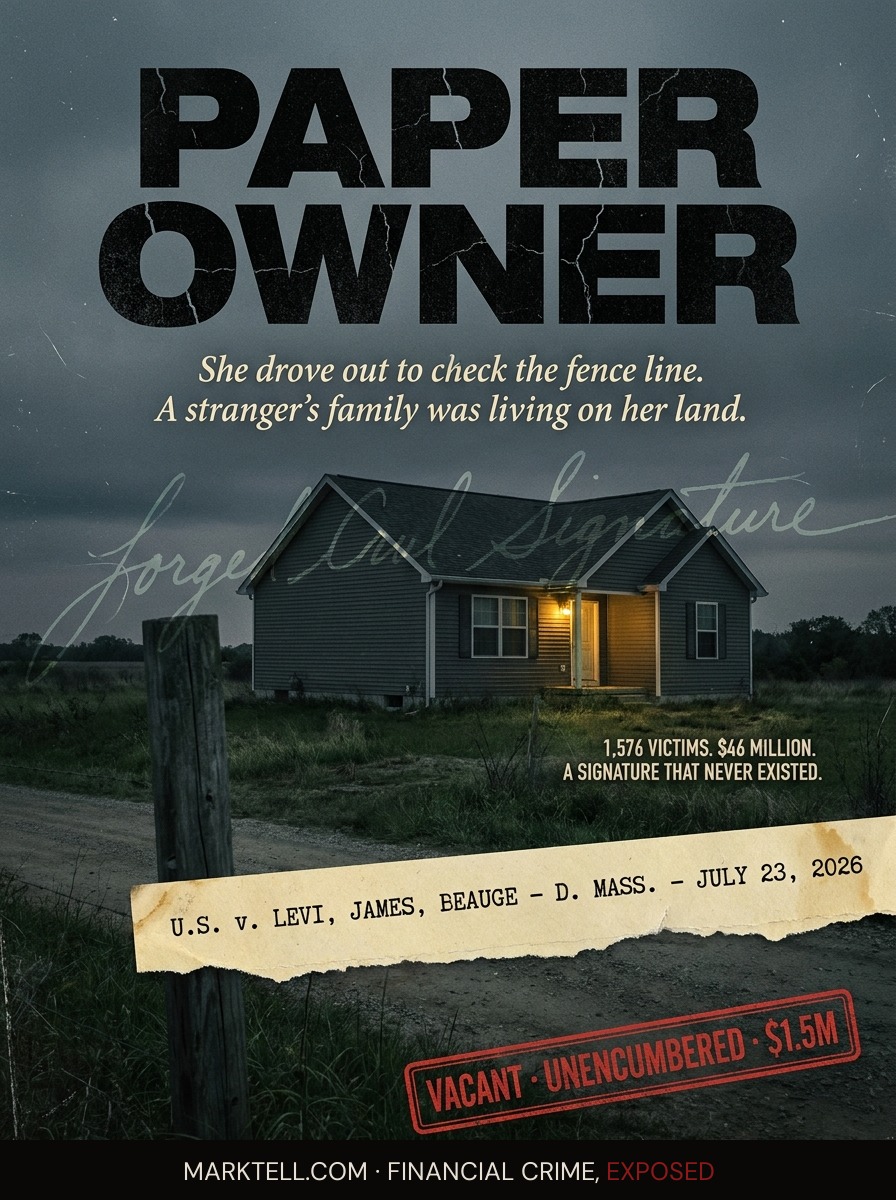
Halla drove out to Concord on a Saturday in the spring to look at the fence line.
She and Omar had owned the lot for years. It was going to be a house someday, when they were ready, when the kids were grown, when the market stopped doing whatever the market was doing. In the meantime it was a rectangle of grass and trees off a road they visited a few times a year. Vacant. Unencumbered. That is the language the bank used. It meant no mortgage. It meant nobody was watching the property the way a bank watches a property.
She was watching it. That was the arrangement.
She parked on the shoulder and stepped out. She was looking for the corner post. What she saw instead was a house.
Framed. Sided. Windowed. A driveway poured. A porch light installed. Somebody's car in the driveway. Not a construction site. A home. Finished enough that a family had already moved into it.
Halla stood on the road for a long time. She checked the address on her phone. She checked the plat map she kept in a folder in her email. She walked to the corner post and found it, exactly where it had always been, and looked back at the house that was standing on her land.
That is where this chapter begins. Not with the indictment. With the moment a woman realized that somewhere, on paper, there was a version of her husband who had signed away a piece of ground she could see with her own eyes.
I.
The federal indictment unsealed by the U.S. Attorney's Office for the District of Massachusetts on July 23, 2026 tells the story from the other end. It names three men. Moshe Levi, 57, of Carrollton, Texas. Kyon James, 44, of Middleboro, Massachusetts. Bradley Beauge, 41, of Somerset, New Jersey. All three were arrested on July 16, 2026. Levi is charged with wire fraud conspiracy and money laundering conspiracy. James and Beauge are charged with money laundering conspiracy.
According to the indictment, the scheme ran from approximately June 2023 through June 2024. The alleged proceeds totaled approximately $1.5M. The targets were vacant, unencumbered properties in Massachusetts, Georgia, Indiana, and Tennessee, most of them owned by people who lived somewhere else.
Read that part slowly. Vacant. Unencumbered. Out of state.
Those are not adjectives. Those are targeting criteria.
A property with a mortgage has a bank watching it. A property with a resident has a person walking through it. A property with an in-state owner has someone who drives past. A vacant lot owned by someone in another state has none of that. It sits on a database. It waits.
The machine in this case did not need to hack anything. It needed to build a person.
II.
Here is the kit, as the federal filings describe it.
A driver's license in the real owner's name, with somebody else's photograph.
A passport, if the closing needed one.
An email account in the real owner's name, opened at a free provider.
A phone number through an internet telephony service, so the calls would ring somewhere the fraudsters could answer.
A signature that matched, close enough, the one on file.
That is the whole apparatus. A wallet you could hold in your hand. A person who existed only in the drawers of a title company for the length of one transaction.
The alleged sequence, as described in the indictment: identify the property. Build the paper owner. Contact a real estate professional in the state where the property sits. List it. Find a buyer, an ordinary buyer who has no reason to think the seller is anyone other than the name on the deed. Close the sale. Wire the proceeds into an account. Move the proceeds through other accounts. Disappear the paper owner.
The buyers were not the marks in the traditional sense. Their money was real. Their intent was real. Their title, in the end, was not. A forged deed is legally invalid. The real owner does not lose title. The buyer loses the money.
Which is why, months or years later, the real owner drives out to check the fence line and finds a stranger's house on it.
III.
Halla did not know about the indictment when she stood on the road. The indictment did not exist yet.
She knew only what she was looking at.
She called Omar. He drove out. They stood on the road together. They walked up the driveway. They did not knock on the door, because they did not know what they would say. What they would say is not a script anyone gives you. There is no chapter in any homeowner's manual about what to say to the family living in the house that was built on the land you still, legally, own.
They drove home. They pulled the deed out of the file cabinet. They found the plat map. They found the tax bills, which they had been paying, on time, every year, on a property that had been sold out from under them without their knowledge.
That part may be the hardest to hold. The taxes kept arriving. They kept paying. The county kept cashing the checks. Somewhere in the same county's registry, a different transaction had been recorded, in their names, with signatures that were not theirs.
Two versions of them existed in the public record. One paid the taxes. One sold the land.
IV.
The FBI Boston Division has been warning about this for years. Between 2019 and 2023, according to the field office, 1,576 victims in Massachusetts reported over $46M in losses to real estate fraud. The number is climbing.
Quit claim deed fraud, the bureau calls it. Title theft. The names are polite. What they describe is a specific mechanism that works because the American property record system was built on the assumption that the person signing the deed is the person named on the deed. That assumption used to be defended by geography. You had to walk into an office. You had to be seen. Now the office is a Zoom call and the seeing is a photograph of a driver's license on a screen.
The machine adapted. The record system did not.
U.S. Attorney Leah B. Foley and Ted E. Docks, Special Agent in Charge of the FBI's Boston Field Office, announced the charges. Assistant U.S. Attorney Seth B. Kosto, Chief of the Securities, Financial and Cyber Fraud Unit, is prosecuting.
Wire fraud conspiracy carries up to 20 years. Money laundering conspiracy carries up to 10. Those are ceilings, not sentences. What the defendants receive, if convicted, will be less. Allegation is not adjudication. All three men are entitled to the presumption of innocence.
V.
Here is what the case does not resolve, even if every count sticks.
The buyers who paid real money for legally invalid deeds still lost the money.
The owners whose properties were sold without their knowledge still have to prove, in court, that the version of them who signed the deed was not them. That process takes years and lawyers and thousands of dollars.
The house on Halla's lot is still standing. Somebody's family lives inside it. That family paid a real price to a paper version of a real man. The paper man got the money. The family got a piece of land they cannot legally hold. Halla and Omar got their land back on paper and a title dispute they did not ask for.
Nobody in that sequence walks away whole.
VI.
If you own a vacant property in another state, the FBI's advice is not comfortable. Sign up for alerts with the county registry of deeds if the county offers them. Check the record on your property periodically. Consider a property monitoring service. If you are elderly, or your parent is elderly, and there is land in the family that nobody visits, drive out to it. Look at it. Take a photograph. Do it once a year.
Not the exciting advice. Not the television advice. The ugly advice.
The machine is looking for a rectangle of grass with nobody standing on it. The defense is a person standing on it.
VII.
Halla went back to Concord the next weekend. She sat in the car for a while before she got out.
The house was still there. The porch light was on. Someone had put a plant on the front step.
She thought about the version of her husband who existed somewhere in a filing cabinet in a title office. A man with Omar's name and someone else's face. A man who had walked, on paper, into a room and sold a piece of land he did not own. A man who did not know Omar and had never met her.
That man did not have to answer for anything. He was ink. He was going to be dissolved back into the drawer he came from, whenever the lawyers were done.
The house stayed. The family stayed. The taxes would keep arriving.
The land was theirs. It had always been theirs. That was the part that hurt. The paper had lied and the ground had not, and neither one was going to give the money back to the family in the house.
- U.S. Attorney's Office, District of Massachusetts | July 23, 2026 | Announcement of charges against Moshe Levi, Kyon James, and Bradley Beauge
- Federal indictment | July 2026 | Wire fraud conspiracy and money laundering conspiracy charges
- FBI Boston Division | Public advisories 2023-2026 | Quit claim deed fraud warnings and statistics (1,576 Massachusetts victims, $46M in losses, 2019-2023)
- Yahoo News aggregation | July 26, 2026 | Reporting on the Massachusetts deed fraud case
Editorial Notice
MarkTell is a true crime publication about financial fraud. Some scenes, dialogue, and sequential details are reconstructed from court filings, enforcement actions, news reports, and public records. Where the public record does not provide exact details, editorial reconstruction is used to convey the documented pattern of events. Names of private individuals may be changed to protect identity. All factual claims are sourced to public documents cited in the Evidence Trail above. MarkTell does not provide investment, legal, or financial advice. Nothing published here constitutes a recommendation to buy, sell, or avoid any investment. Allegations described in active cases have not been adjudicated and defendants are presumed innocent until proven guilty. Readers should conduct their own due diligence before making financial decisions.