The gallery kept the lights on. The paintings were never there.
Seojung Art sold nine years of monthly returns on paintings that had already been sold, or never existed at all. A Seoul court just put the CEO away for eighteen years. The 981 people who signed the contracts are still counting what is gone.
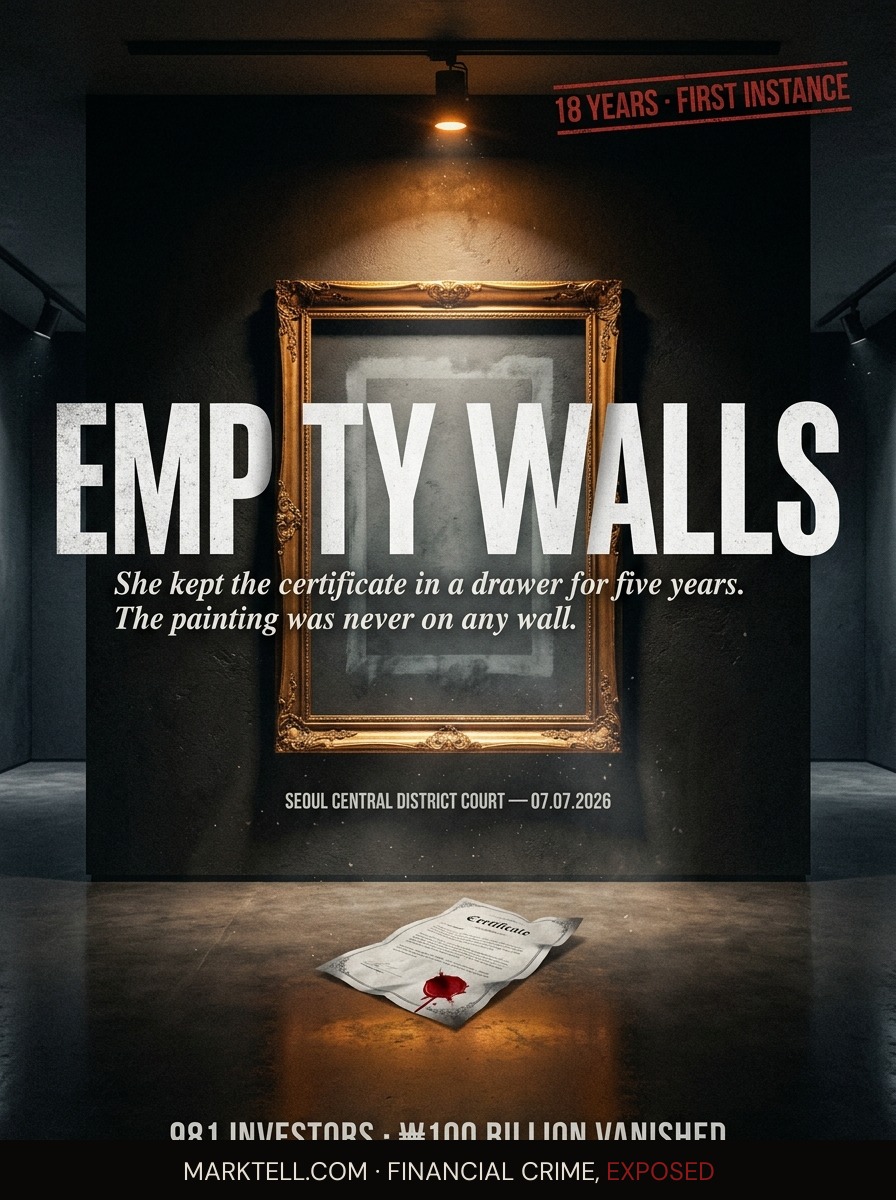
Ji-won kept the certificate in a plastic sleeve in the drawer under her kitchen phone. She was sixty-two. She had taught middle-school music for thirty-one years, and when she retired in 2019 a friend from her church choir told her about a gallery in Cheongdam that let you buy a painting and keep the returns while the gallery kept the wall.
The certificate said she owned a canvas by a mid-career Korean painter. The gallery would exhibit it, rent it to hotels and corporate lobbies, and pay her between 0.8 and 1 percent every month. At the end of the contract she would get her principal back. That was the promise, in Korean, on paper, with a red company seal.
For almost five years the app on her phone showed a green line that ticked upward every month. She never went to see the painting. Nobody suggested she should. The gallery had a real building. It had openings. It appeared at KIAF. Her friend's returns had come in every month for two years before Ji-won signed anything. That was the pitch, and it was not really a pitch. It was a room that already looked full.
In May 2024 the green line stopped moving.
I.
Seojung Art was founded in 2015 by a man named Lee Dae-hee. It presented itself as a contemporary gallery dedicated to Korean artists, exhibitions, education, print production. It attended the fairs. It ran the programs. The public face was a legitimate gallery. That was the point.
The investment side ran alongside it. Investors were invited to purchase specific artworks and "consign" them back to the gallery. Seojung Art would generate income from those works, it said, through exhibitions, rentals to companies and hotels, print licensing. The gallery guaranteed the principal on the back end. In the middle, it paid a monthly return.
Read the two numbers slowly. Zero point eight to one percent. Per month. Compounded, that is roughly ten to twelve percent a year, guaranteed, on a physical object the gallery was allegedly monetizing on your behalf. In a country where bank deposits paid two to three.
That number is the doorway. Everything else is the room behind it.
II.
The room behind it was mostly empty.
According to the Seoul Central District Court's first-instance ruling issued on July 7, 2026, many of the artworks investors believed they owned either did not exist or had already been sold to someone else. Investigators found that most investors never physically verified their purchases. There was no walk-through. There was no inventory audit. There was a certificate, and there was an app, and there was a gallery with a real front door.
The court found that between 2016 and 2025, Seojung Art took in more than KRW 100 billion (about $70M USD) from 981 investors. Some reporting puts the figure above KRW 110 billion. Monthly returns were paid using money from later investors. That is the definition of a Ponzi. The court used the statute.
Lee Dae-hee was charged with fraud under the Act on the Aggravated Punishment of Specific Economic Crimes and with violating the Act on the Regulation of Conducting Fund-Raising Business Without Permission. The court ordered him to forfeit approximately KRW 14.19 billion (about $10.2M USD) that it identified as criminal proceeds he had personally pocketed.
Eighteen years.
That was the sentence. First instance. He has appealed.
III.
Picture the gallery on a Friday night in 2022. The lights are on. The wine is on the tray. A curator is walking a small crowd past a wall of new work. Somewhere in a back office, a spreadsheet is being updated. New money in. Old money out. The wall in the front room is real. The painting Ji-won owns, according to the certificate in her drawer, is not on that wall. It is in a warehouse she has been told about but has never seen.
That is the machine. A stage set with a working front and a hollow back. The front room gets the openings. The back room gets the spreadsheet. The certificate gets the seal. The painting gets a location that nobody checks.
The front is what let the machine run for nine years.
Seojung Art built a public reputation. It participated in the fairs a real gallery participates in. It hosted exhibitions a real gallery hosts. When Ji-won's friend recommended it, she was not recommending a con. She was recommending a place she had been, with people she had met, that had paid her every month for two years. The pitch was the friend. The friend had been paid with a later friend's money. Neither of them knew.
The mark is not stupid. The mark is inside the room.
IV.
May 2024. The monthly distribution did not arrive.
Ji-won opened the app. The message said the gallery was making a "temporary payment adjustment." She called the number on the certificate. Someone answered. Someone was calm. Someone told her the payments would resume once the gallery completed a review of its rental contracts.
She waited two months. She called again. The tone had changed. In the news she started to see the word "art-tech" and the word "postponement" and then the word "complaint."
By July 2025 investors had filed for corporate rehabilitation of Seojung Art to freeze the assets and the liabilities. In December 2025 Lee Dae-hee was arrested. In January 2026 he was indicted. On July 7, 2026, the court read the sentence.
At trial, Lee argued that the dealers who had recruited investors on the gallery's behalf should be treated as accomplices. The court rejected the argument. The court described the scheme as one that "undermined trust in the domestic art market as a whole" and "distorted sound economic order." Read that language. It is a court naming a machine.
V.
The Seojung Art case is not the only one. In 2024, two other Korean galleries operating similar "art-tech" schemes, GALLERY K and JW ART GALLERY, collapsed after allegedly defrauding over a thousand people of roughly KRW 100 billion between them. The pattern is now visible enough that Korean regulators and reporters have a shorthand for it.
The pattern is: a real gallery, a real exhibition calendar, a real reputation, and a paper claim of ownership on a physical object nobody ever sees. The pattern is: monthly returns paid in cash, principal "guaranteed" on the back, and no independent audit of the underlying artworks. The pattern is: the friend who tells you about it has been receiving money for two years.
The renaming is simple. This is not art investment. This is a note. It is an unregistered debt instrument backed by an asset the issuer controls, does not disclose, and may not possess. The painting is not the investment. The painting is the cover story for the note. The note is the fraud.
VI.
Ji-won still has the certificate.
She keeps it in the same drawer, in the same plastic sleeve. She has thought about throwing it away. She has not thrown it away. It is evidence now, though nobody has asked her for it, and the case has moved past the point where her particular certificate matters.
Her retirement was built around the green line on the app. Not entirely. She had a pension. She had the apartment. But the green line was the part that was going to pay for the small things she had told herself she would do when she stopped teaching. The trip to see her sister in Vancouver. A better piano for the grandchildren. A new coat every second winter.
She has not calculated how much she lost. She knows the number. She has not written it down.
She was told she owned a painting. She was told it was hanging somewhere useful, earning its keep, waiting for her. The court has now told her that the painting, in all likelihood, was not there.
The gallery kept the lights on for nine years.
The paintings were never there.
- K-ARTNOW | July 2026 | "Seojung Art CEO Sentenced to 18 Years in Prison for Art Investment Ponzi Scheme"
- Seoul Central District Court, Criminal Division 23 | July 7, 2026 | First-instance ruling in the prosecution of Lee Dae-hee
- Act on the Aggravated Punishment of Specific Economic Crimes (South Korea) | statute cited in charging documents
- Act on the Regulation of Conducting Fund-Raising Business Without Permission (South Korea) | statute cited in charging documents
- Korean art market reporting on "art-tech" fraud cases, 2024-2026 | contextual reference to GALLERY K and JW ART GALLERY collapses
- Corporate rehabilitation filings against Seojung Art | July 2025
Editorial Notice
MarkTell is a true crime publication about financial fraud. Some scenes, dialogue, and sequential details are reconstructed from court filings, enforcement actions, news reports, and public records. Where the public record does not provide exact details, editorial reconstruction is used to convey the documented pattern of events. Names of private individuals may be changed to protect identity. All factual claims are sourced to public documents cited in the Evidence Trail above. MarkTell does not provide investment, legal, or financial advice. Nothing published here constitutes a recommendation to buy, sell, or avoid any investment. Allegations described in active cases have not been adjudicated and defendants are presumed innocent until proven guilty. Readers should conduct their own due diligence before making financial decisions.