The franchise that was never a franchise, and the deposit that was never a deposit
A Delhi cafe brand promised assured monthly returns to people who thought they were buying a franchise. The Economic Offences Wing says the kitchen was a cash register pointed the wrong way.
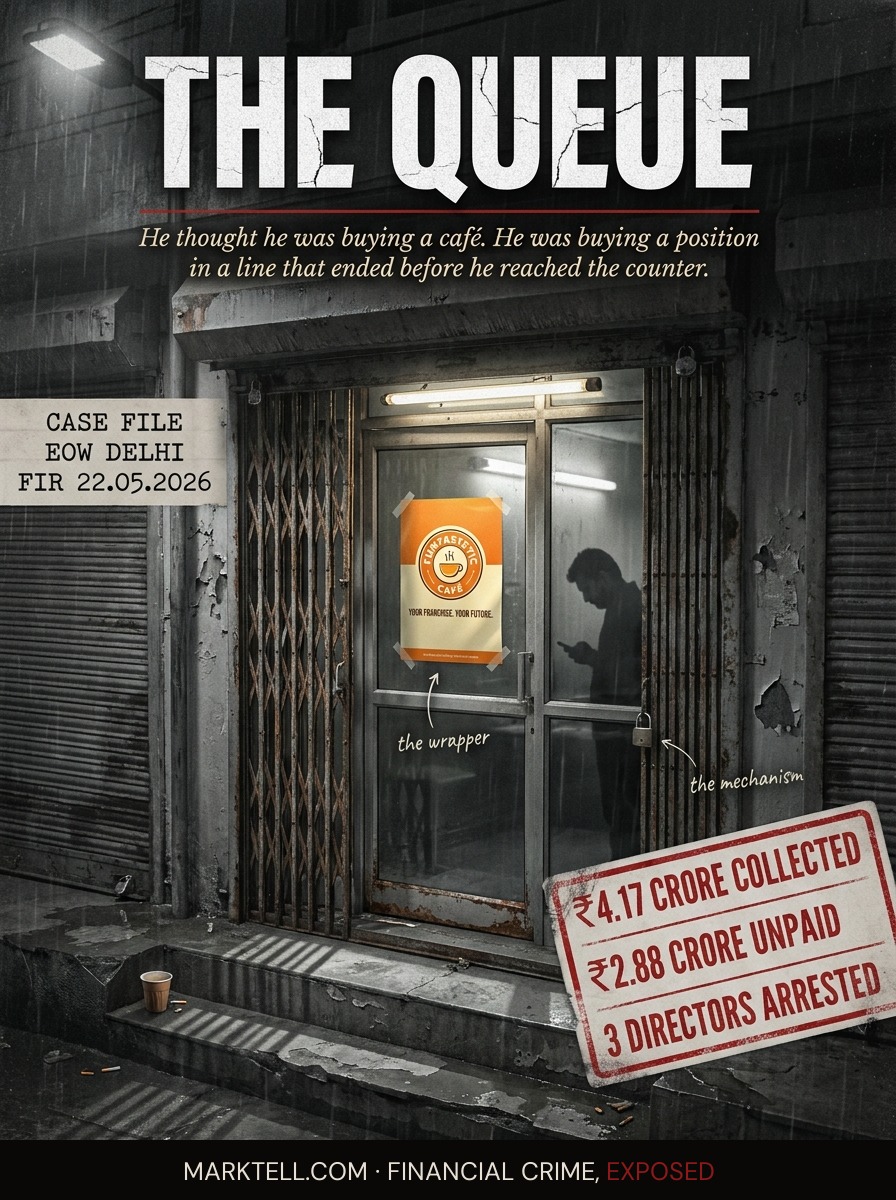
Rakesh was forty-four when he signed the paperwork. He had been a logistics supervisor for eleven years. He had saved for eight. He took a half day off work and rode the metro to Laxmi Nagar, because the office was in the basement of a building near Vijay Chowk and he wanted to see the place with his own eyes before he wired anything.
The office smelled like fresh paint and printer toner. The desk was glass-topped. A brochure sat on a small stand, the kind of stand a restaurant uses for the day's specials. On the brochure was a logo and a word that looked like a pun and a promise. FunTasteTic Cafe. The man across the desk asked Rakesh about his savings the way a doctor asks about symptoms. Politely. With a clipboard.
The pitch was a franchise. That is the first thing to understand. Nobody told Rakesh he was investing in a scheme. He was told he was becoming a small business owner. He was told there would be training. Branding support. Mentorship. A turnkey cafe. The investment band was five to ten lakh rupees, depending on the package. There would be assured monthly returns while the cafe was being built out. There would be referral commissions if he brought other people in.
He brought other people in.
That is the part he will think about later, in the quiet hours, more than the money itself.
II. The wrapper.
Every Ponzi scheme has a wrapper. The wrapper is the legitimate-looking thing on the outside. Real estate. Crypto. Forex. Cattle. Teak plantations. Cafes. The wrapper is what lets the operator say the word "business" with a straight face. The wrapper is what lets the investor say the word "franchise" to his wife.
Underneath the wrapper, the mechanism is always the same. New money pays old money. The returns are not generated. They are circulated.
Duvera Retails Pvt Ltd was incorporated on January 19, 2023. Its authorized and paid-up capital, on file with the Ministry of Corporate Affairs, was Rs 1 lakh (about $1.2K USD). That is the entire equity base. One lakh rupees. Less than the cost of a single franchise package.
Read that slowly.
A company capitalized at one lakh was, according to the EOW, collecting crores from investors. The reported revenue for the financial year ending March 31, 2024 was Rs 2.23 crore (about $267K USD). The alleged total collected from investors was Rs 4.17 crore (about $500K USD). The unpaid amount, according to the police, is approximately Rs 2.88 crore (about $345K USD).
The wrapper says cafe. The numbers say something else.
III. The chair Rakesh sat in.
For the first few months, the system worked the way the man at the desk said it would. The UPI credit arrived. Rakesh would check his phone in the morning and see the notification and feel, for a moment, like a man who had made a correct decision.
He told his brother-in-law about it. His brother-in-law put in two lakh.
He told a colleague at the warehouse. The colleague put in three.
The referral commissions arrived too. Smaller, but real. He thought of them as a gift. He thought of himself as a kind of guide.
This is the part of the machine that the directors did not have to build. The investors built it. The structure of the scheme made every early investor into a recruiter, because the structure rewarded recruitment. The directors did not have to find a thousand people. They had to find a few hundred, and the few hundred would find the rest.
That is the multi-level part. MLM is a sales structure where you earn money from your own sales and also from the sales of people you bring in, and the people they bring in, and so on. When the product is real, MLM is controversial. When the product does not exist, MLM is a recruitment funnel for a Ponzi.
IV. The month it stopped.
The credit did not arrive in April. Rakesh checked the app three times. He thought it might be a holiday delay. He called the number on the brochure. A man answered. The man said there was a technical issue with the disbursements. The man said it would be resolved.
In May, nothing arrived.
The phone number stopped connecting in the second week of May. The website went down. Rakesh went back to Laxmi Nagar on a Saturday and stood in front of the basement office with the gate pulled down. The brochure was still taped to the inside of the glass. He could see it from the street. The logo. The word. The promise.
According to the EOW, the company defaulted on payments, shuttered its offices, took down its online platforms, and stopped responding to investors. A complainant named Sanjay Jagdish, along with other investors, filed a complaint that became an FIR on May 22, 2026. On June 29, 2026, Delhi Police arrested three directors of Duvera Retails Pvt Ltd: Bhoop Singh, Gaurav Verma, and Sanjeev Sharma. The case is being investigated under provisions that include the Prize Chits and Money Circulation Schemes (Banning) Act, 1978, the Indian law specifically written for this kind of structure.
Allegation is not adjudication. The directors have not been convicted. The investigation continues.
V. What the wrapper hid.
A legitimate franchise operator does not pay you a monthly return on your franchise fee. A legitimate franchise operator collects the fee and then earns from your operating profits, the way a landlord earns from rent. Assured monthly returns on a franchise deposit, with no cafe yet open, is not how franchises work. It is how deposits work. And taking deposits from the public, in India, requires a license Duvera Retails did not have.
The man at the glass-topped desk did not call it a deposit. He called it a franchise investment. The word changes the regulator. The word changes the protections. The word changes who, when it all goes wrong, will pick up the phone.
Rakesh did not know this. He should not have had to. The vocabulary of the pitch was designed to keep him from knowing.
VI. What he lost.
He lost eight lakh rupees. He lost the conversation he is going to have to have with his brother-in-law, who lost two. He lost the colleague at the warehouse, who has stopped eating lunch with him. He lost the eight years.
That part may be the saddest.
In the broader Indian market, the FunTasteTic case is small. Rs 4.17 crore is not the headline number that makes a news cycle. Earlier this month, Hyderabad police disrupted a scheme called IGNITE that they estimated could have grown to Rs 5,000 crore (about $600M USD). Since January 2025, regulators have identified 686 MLM scams among 775 new MLM operations in India. The cafe is one room in a very large building.
But the room has a door. And the door has a name on it. And the name on the door, in a thousand variations, is what the next thousand Rakeshes will read before they sign.
The wrapper next time will not say cafe. It will say cloud kitchen. It will say EV charging franchise. It will say organic dairy. The wrapper is the part the operator changes. The mechanism is the part he does not.
He bought a cafe. He bought a position in a queue. The queue ran out before he reached the counter.
- The Tribune | June 30, 2026 | "Delhi Police arrest 3 directors in Rs 4.17-crore FunTasteTic Cafe MLM-Ponzi fraud"
- Delhi Police Economic Offences Wing | June 29, 2026 | Arrest announcement and case summary
- Ministry of Corporate Affairs (India) | filings on record | Duvera Retails Pvt Ltd incorporation (Jan 19, 2023), authorized/paid-up capital, FY2024 revenue
- Prize Chits and Money Circulation Schemes (Banning) Act, 1978 | statutory framework
- FIR registered at Delhi Police | May 22, 2026 | complaint of Sanjay Jagdish and other investors
- Hyderabad City Police | June 11, 2026 | "Operation Ignite Crackdown" public release (contextual)
Editorial Notice
MarkTell is a true crime publication about financial fraud. Some scenes, dialogue, and sequential details are reconstructed from court filings, enforcement actions, news reports, and public records. Where the public record does not provide exact details, editorial reconstruction is used to convey the documented pattern of events. Names of private individuals may be changed to protect identity. All factual claims are sourced to public documents cited in the Evidence Trail above. MarkTell does not provide investment, legal, or financial advice. Nothing published here constitutes a recommendation to buy, sell, or avoid any investment. Allegations described in active cases have not been adjudicated and defendants are presumed innocent until proven guilty. Readers should conduct their own due diligence before making financial decisions.