The false name held for thirteen months. The paperwork held for five years.
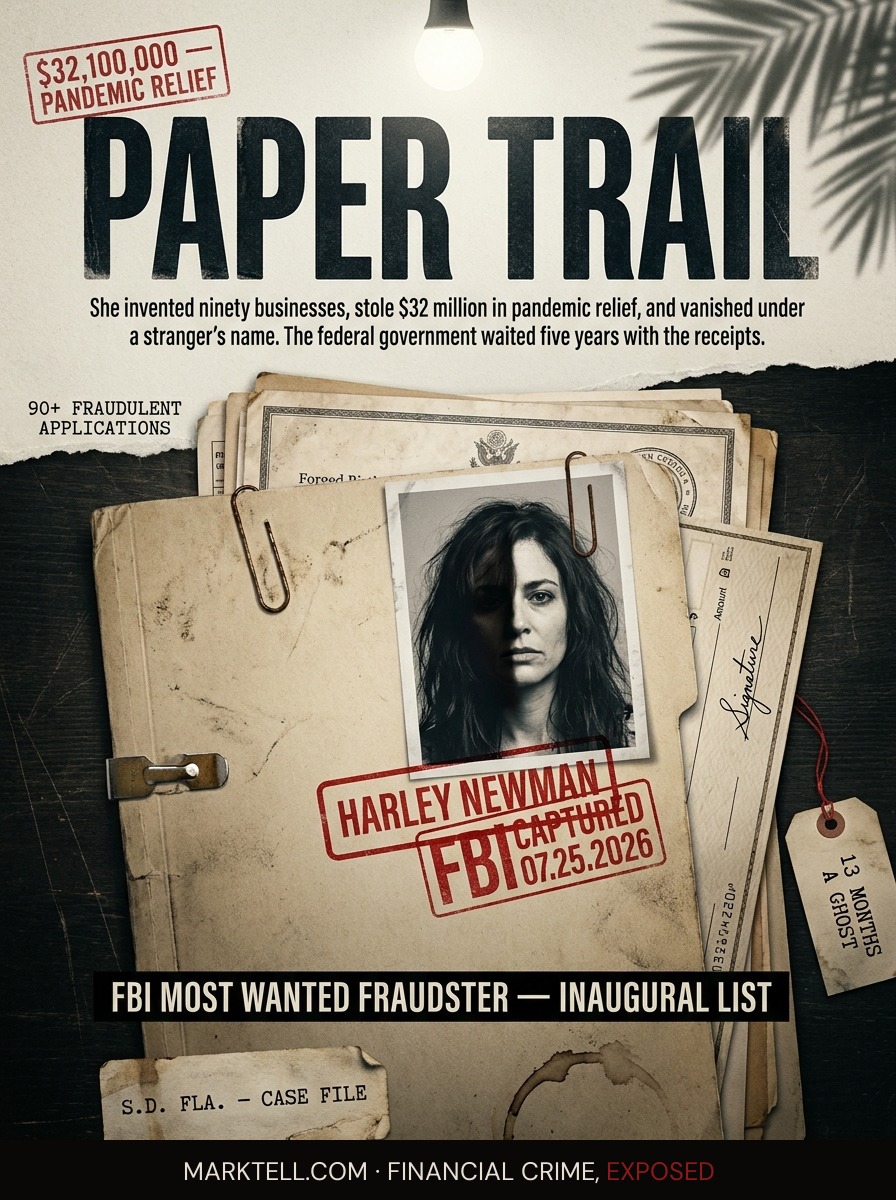
Elaine Angene Escoe allegedly ran ninety fake relief applications through four federal programs, then disappeared into an alias in Jamaica. The paperwork was waiting when she came back.
Marcus refreshed the page again. The SBA portal showed a spinning wheel and a message that said the site was experiencing high traffic. It was June 2020. His kitchen counter had a manila folder on it, the kind with the metal clasp, and inside the folder were four years of Form 941 quarterly filings, the EIN assignment letter from 2011, and a printed spreadsheet of the eleven people whose paychecks he cut every other Friday.
He was fifty-eight. He had been the payroll clerk at a small metal-stamping shop outside Dayton for nineteen years. When the Paycheck Protection Program opened, his boss asked him to handle the application because he was the one who knew the numbers. He knew the numbers. That was the problem. The numbers were real. Real numbers took longer to enter than fake ones.
His application would sit in the queue for eleven weeks. The shop would lay off four people in the interim. Two of them would not come back.
Somewhere in Miami, on a day Marcus was refreshing the portal, a different application was being approved in minutes. The business on that application did not exist. The employees on that application did not exist. The payroll numbers were made up. The bank statements attached to the file had been fabricated. The IRS documents had been forged.
The federal indictment, unsealed later in the Southern District of Florida, would allege that this pattern repeated itself more than ninety times over eighteen months, and that the person behind many of those applications was a Miami woman named Elaine Angene Escoe.
I.
The alleged scheme ran from May 2020 through November 2021.
Escoe, 41, and five co-defendants allegedly submitted more than ninety applications across four federal relief programs. According to the indictment, the applications collected approximately $29.1M in Paycheck Protection Program funds, $3.8M in Shuttered Venue Operators Grant funds, and $1.2M in Restaurant Revitalization Fund money. The total the government puts at more than $32M.
Read those program names slowly. Paycheck Protection. Restaurant Revitalization. Shuttered Venue Operators. Each one was written into law to keep something alive during a specific kind of pain. A payroll. A dining room. A concert hall.
The indictment alleges that none of the businesses on Escoe's applications qualified for any of it. The employee counts were inflated. The payroll expenses were invented. The revenue figures were fabricated. The tax documents supporting all of this were forged. The bank statements were made up.
That is the paperwork machine. That is what it does. It looks correct.
II.
The five co-defendants have already been convicted or have pleaded guilty. That part is adjudicated. That part is not in dispute anymore.
The record describes what happened to the money after it landed. Funds moved between co-conspirator accounts. Payments went to businesses the defendants themselves controlled. Large sums were pulled out in cash. And there were blank checks, pre-signed, used to move money in a way that concealed where it came from and who was moving it.
A pre-signed blank check is a small object. Sit with it for a second. Somebody signs a check with no amount and no payee written on it, and hands it to somebody else, and that somebody else fills in whatever they need. It is a piece of paper that says trust me, or say nothing. It is the physical form of a conspiracy.
Marcus, in Ohio, was still waiting on his portal to load.
III.
A federal arrest warrant for Escoe was issued on May 22, 2025.
She was told to appear in court on June 5, 2025. She was last seen in Palm Beach County on June 3, 2025. She did not appear.
She went to Jamaica. She lived there under a name that was not hers. The alias in the FBI's material is Harley Newman. There were others, according to the record. Annie. Annie Palmer. The names moved the way the money had moved. From one account to another. From one identity to another.
On June 4, 2026, the FBI announced its inaugural Most Wanted Fraudster list. Kash Patel, the Director, put eight names on it. Escoe was one of them.
Fifty-one days later, on July 25, 2026, she was captured in Jamaica and returned to the United States.
The apprehension involved the U.S. Marshals Service, the State Department's Diplomatic Security Service, the U.S. Embassy in Kingston, the Jamaica Constabulary Force, and the JCF's Fugitive Apprehension Team. That is the honest paperwork machine. It moves slower than the fraudulent one. It also does not stop.
IV.
The charges against Escoe are conspiracy to commit wire fraud, conspiracy to commit money laundering, wire fraud, concealment money laundering, and transactional money laundering.
Read them again. Two conspiracies. Two kinds of money laundering. Concealment laundering hides where money came from. Transactional laundering moves money through legitimate-looking transactions to give it a story. Wire fraud is the underlying theft. The indictment structure is telling you that the government is not just alleging she took the money. It is alleging she and her co-defendants built an apparatus to hide the money after they took it.
Allegation is not adjudication. She will get a trial. Her co-defendants did not.
V.
The Department of Justice reported in April 2024 that its COVID-19 Fraud Enforcement Task Force had charged more than 3,500 defendants for losses exceeding $2B, and had seized more than $1.4B in stolen funds. The government's own estimate of total fraud across all pandemic relief programs runs into the hundreds of billions.
$2B charged. Hundreds of billions estimated stolen. Do the math. The task force is prosecuting a percentage of a percentage.
That is not a failure of the task force. That is the scale of what the paperwork machine did while everyone was inside their houses.
Marcus's application eventually cleared. The shop kept eight of its eleven people. He does not know, and will never know, whose fake application was processed on the day his real one was not. He does not need to know. The mechanism does not depend on the specific pairing. It depends on the fact that the portal only had so much bandwidth, and the fraudulent applications were shorter, cleaner, and required no genuine documents to assemble.
The honest paperwork took longer because it was honest.
VI.
Escoe is back in the Southern District of Florida now. She will be arraigned. She will enter a plea. The case will move through the docket that her co-defendants have already moved through.
The alias held for thirteen months. The federal indictment held for five years. One of those is a longer number than the other, and that is the whole story.
She fled the paperwork. The paperwork was waiting when she came back.
- NBC 6 South Florida | July 25, 2026 | Miami woman charged in $32M COVID relief fraud scheme captured in Jamaica
- U.S. Department of Justice, Office of Public Affairs | 2026 | Statements from Acting Attorney General Todd Blanche and Assistant Attorney General Colin M. McDonald, National Fraud Enforcement Division
- Federal Bureau of Investigation | June 4, 2026 | Announcement of inaugural Most Wanted Fraudster list by Director Kash Patel
- U.S. District Court, Southern District of Florida | May 22, 2025 | Federal arrest warrant for Elaine Angene Escoe
- DOJ COVID-19 Fraud Enforcement Task Force | April 2024 | Progress report on charges and seizures
Editorial Notice
MarkTell is a true crime publication about financial fraud. Some scenes, dialogue, and sequential details are reconstructed from court filings, enforcement actions, news reports, and public records. Where the public record does not provide exact details, editorial reconstruction is used to convey the documented pattern of events. Names of private individuals may be changed to protect identity. All factual claims are sourced to public documents cited in the Evidence Trail above. MarkTell does not provide investment, legal, or financial advice. Nothing published here constitutes a recommendation to buy, sell, or avoid any investment. Allegations described in active cases have not been adjudicated and defendants are presumed innocent until proven guilty. Readers should conduct their own due diligence before making financial decisions.