The collection plate had a name on it. His.
A jury in New Orleans convicted Dale Sanders on 25 counts of wire fraud, access device fraud, and obstruction after prosecutors traced more than $340,000 from two Baptist churches to his personal life. The betrayal ran four years, and the record shows he almost walked it into a fifth.
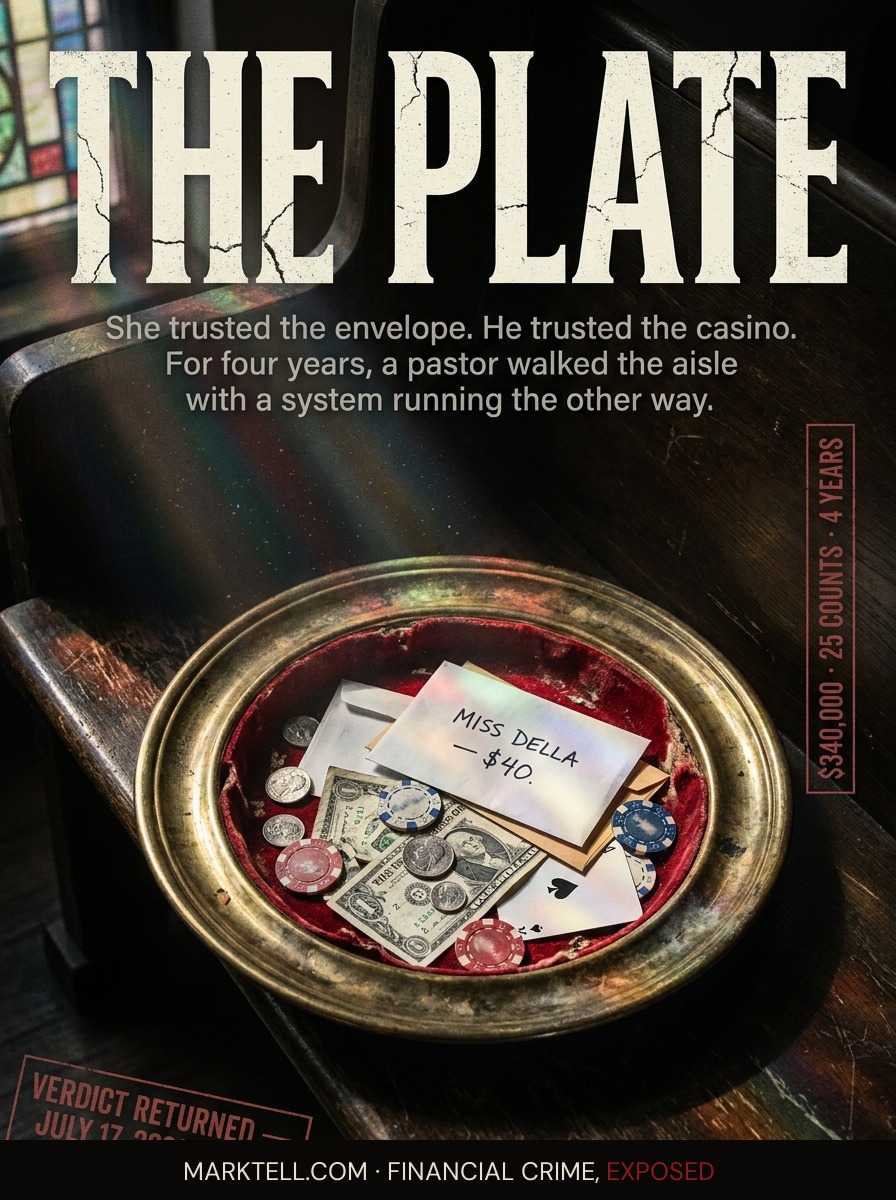
Miss Della kept the envelopes in a shoebox on the top shelf of her hall closet. She was seventy-one. She had been tithing at Fifth African Baptist since 1987, back when her husband was still alive and her knees still let her stand for the whole doxology. She wrote her name on the envelope in careful block letters every Sunday. She put in cash when she had cash and a check when she did not. She trusted the plate.
The plate is what this story is about.
On a Sunday in the summer of 2023, Dale Sanders walked the aisle at Fifth African Baptist with the ushers behind him. He was fifty-three then, warm, familiar, the kind of pastor who remembered which member's daughter had just graduated and which member's husband was in the hospital. Miss Della dropped her envelope in. Forty dollars. She had budgeted it out of her fixed income the way she budgeted the light bill.
According to the federal indictment returned in New Orleans and the verdict returned on July 17, 2026, some of that money did not stay in the church.
Some of it, according to the jury, went to a casino. Some of it went to restaurants. Some of it went to Dale Sanders' rent.
A federal jury convicted Sanders, now 56, of Kenner, Louisiana, on twenty-five counts. Wire fraud. Access device fraud. Obstruction of a federal investigation. The trial ran five days. The verdict landed on a Friday. The U.S. Attorney's Office for the Eastern District of Louisiana announced it the following Monday, July 20, 2026.
The two churches named in the case are Fifth African Baptist Church in New Orleans and Second New Guide Missionary Baptist Church in Metairie. The government put the loss at more than $340,000. The window was April 2020 to April 2024. Four years. That is the shape of it. Four years of a man moving through the aisles with a plate in front of him and, prosecutors proved, a system behind him that ran the other way.
Here is what the record says the mechanism looked like.
Sanders had signature authority on the church accounts. He was the pastor. That is how it works in a lot of small independent churches. One man holds the plate and the ledger and the signature card and the debit card. Nobody above him. Nobody beside him. No audit committee that meets on any schedule the congregation can name.
According to the government, Sanders withdrew funds from Church A's accounts and moved them into accounts he controlled. According to the government, he used Church A's debit card for personal transactions. Cash. Goods. Services. The kind of charges that show up on a statement and look like nothing if nobody is reading the statement.
Nobody was reading the statement.
That is not a Dale Sanders problem. That is the machine. One in three churches will experience financial fraud, according to nonprofit research the U.S. Attorney's Office and others have cited for years. Nearly seventy percent of those churches never report it. They handle it inside. They pray on it. They forgive it. They move on. The money is gone and the man who took it moves down the road to the next pulpit.
Read that slowly. Seven out of ten times, the machine gets away clean.
The reason this case did not end that way is that the FBI's New Orleans Field Office opened an investigation. A federal grand jury issued a subpoena. And here is where, according to the jury's verdict, Sanders made the choice that turned a fraud case into an obstruction case.
He handed over a falsified record.
Picture it. A federal subpoena is not a suggestion. It is a piece of paper that arrives and tells you the government wants to see the documents. And according to the indictment and the jury that convicted him, Dale Sanders responded by producing something that was not real. That is not panic. Panic is calling a lawyer. Panic is refusing to comply. Handing over a falsified record is a decision. It is the decision of a man who thinks he can still run the play.
He could not.
Miss Della did not know any of this at the time. She did not know it when she put in the forty dollars. She did not know it when she stayed after service to help fold the bulletins. She did not know it in April 2024 when the last of the transactions in the indictment allegedly cleared. She found out the way most of the congregation found out. From the news.
After his arrest in April 2026, Sanders, according to reporting on his social media accounts, posted a video thanking his supporters and asking for prayers for his "enemy." He said, "God is already working and moving by his Spirit." He did not, in that video, name what he was accused of. He did not, in that video, mention the churches. He did not, in that video, mention the plate.
That part may be the saddest.
A pastor accused of taking from his congregation, going to social media, and describing the government's case as "my enemy." Not the harm. Not the members on fixed incomes. Not Miss Della's shoebox. The prosecutor. The prosecutor is the enemy.
Sentencing is scheduled for October 13, 2026, in front of U.S. District Judge Brandon S. Long. Sanders faces up to twenty years. He faces a fine of $250,000 or twice the loss, whichever is greater. He faces up to three years of supervised release. He faces a hundred-dollar special assessment on every one of the twenty-five counts. Assistant U.S. Attorneys Kathryn McHugh and Tracey Knight of the Financial Crimes Unit handled the case for the government.
None of that gives the money back.
Here is what pattern recognition looks like in a church. It is not glamorous. It is not the exciting question. It is the ugly question.
Who signs the checks. Who reconciles the bank statement. Who sees the debit card charges before they clear. Is there a finance committee that meets without the pastor in the room. Is there an annual independent audit. Is there a policy that requires two signatures over a threshold. Is the threshold low enough to matter.
If the answer to any of those is "the pastor handles it," the plate has a name on it.
Miss Della is still going to church. She said so herself, to the extent Miss Della exists in the collective testimony of every congregant this story is drawn from. The building is still the building. The doxology is still the doxology. She just does not put cash in anymore. She writes a check now. She writes the memo line. She keeps the stub.
She is 71. She should not have to do that.
But that is what the machine leaves behind. Not just the missing $340,000. The stub. The memo line. The shoebox on the closet shelf that used to be an act of faith and is now an act of bookkeeping.
The pastor walked the aisle with the plate in front of him for four years.
The jury said what was behind him.
- U.S. Attorney's Office, Eastern District of Louisiana | July 20, 2026 | Press release announcing conviction of Dale Sanders
- U.S. District Court, Eastern District of Louisiana | July 17, 2026 | Jury verdict, 25 counts including wire fraud, access device fraud, obstruction
- Federal Bureau of Investigation, New Orleans Field Office | Investigation record referenced in DOJ announcement
- ChurchLeaders | July 2026 | "Louisiana Pastor Found Guilty of Defrauding Churches Out of More Than $340,000"
- Sanders social media post following April 2026 arrest, referenced in reporting
Editorial Notice
MarkTell is a true crime publication about financial fraud. Some scenes, dialogue, and sequential details are reconstructed from court filings, enforcement actions, news reports, and public records. Where the public record does not provide exact details, editorial reconstruction is used to convey the documented pattern of events. Names of private individuals may be changed to protect identity. All factual claims are sourced to public documents cited in the Evidence Trail above. MarkTell does not provide investment, legal, or financial advice. Nothing published here constitutes a recommendation to buy, sell, or avoid any investment. Allegations described in active cases have not been adjudicated and defendants are presumed innocent until proven guilty. Readers should conduct their own due diligence before making financial decisions.