The clinic billed for sessions that never happened. The refugees never knew their names were the product.
An Ohio couple who ran a behavioral-health clinic in Franklin County are accused of billing Medicaid $9.3 million for therapy that prosecutors say never happened, using refugee families as unknowing entries in a ledger. They are believed to be out of the country.
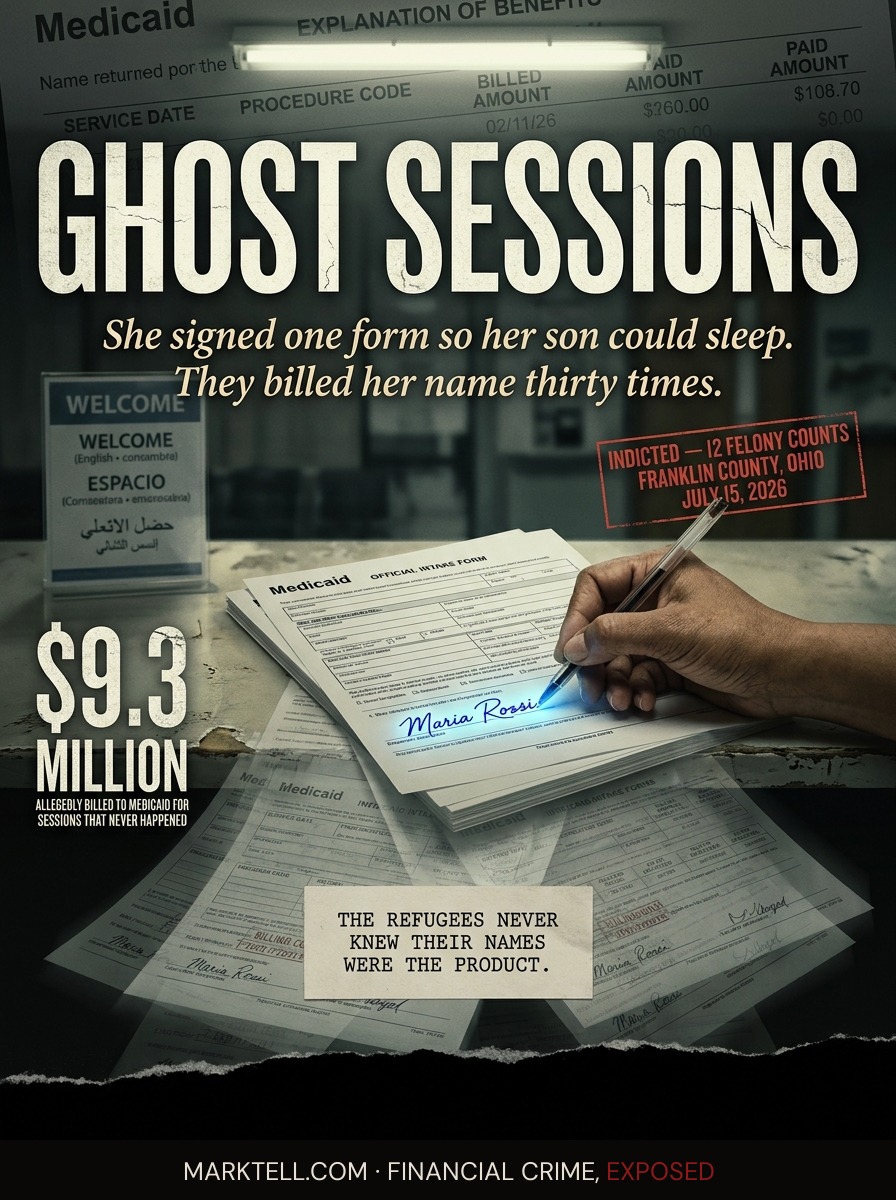
Amina sat in a waiting room in Columbus with a paper cup of water and a form she could not fully read.
She was thirty-four. She had been in Ohio for eleven months. Her son had not slept a full night since the camp. Someone at the resettlement office had given her a name and a number, and the number connected her to a clinic called One Community Mental Health, and the clinic sent a car, and the car brought her here, to a room with mismatched chairs and a plastic bin of toys and a laminated sign that said "Welcome" in three languages, one of them hers.
The woman across the desk spoke her language. That was the thing that made Amina exhale. The woman slid a stack of paper toward her and pointed at the lines. Sign here. Initial here. This is for Medicaid. Medicaid is the program that pays. You do not pay. You do not owe anything. Just sign.
Amina signed.
That is where the story starts. Not with the Porsche. Not with the house in Powell. With a form in a waiting room and a woman who spoke the right language and a mother who wanted her son to sleep.
I.
On July 15, 2026, a Franklin County grand jury indicted Roberta Acheampong, thirty-nine, and her husband Godfred Owusu-Sekyere, forty-six, on twelve felony counts. The Ohio Attorney General's office announced the indictment the same day. The couple, formerly of Powell, Ohio, are believed to be out of the country. Kenya or Ghana, according to the AG's office.
The charges include engaging in a pattern of corrupt activity, telecommunications fraud, theft, forgery, Medicaid fraud, money laundering, and identity fraud. The alleged loss to Ohio Medicaid is $9.3 million.
Read that number again. $9.3 million. Not from investors. Not from a bank. From a program funded by state and federal taxpayers to pay for medical care for people who cannot afford it.
The couple owned and operated One Community Mental Health, a behavioral-health clinic in Franklin County. According to the indictment, they billed Medicaid multiple times a week for entire refugee households for mental-health and therapeutic behavioral services that were never provided. The patients, prosecutors say, did not know. In many cases they had never met the clinician whose name appeared on the claim.
That is the machine. A ghost session. A visit that lived only on a form.
II.
Here is how it is alleged to have worked.
Medicaid pays clinics per service, per patient, per code. A behavioral-health clinic bills for a session using a code that describes what happened during the session. The code has a dollar value. Medicaid pays the value. The clinic collects.
The program is built on trust. Nobody from the state is in the room when the session happens. Nobody checks the door. The clinic says a session occurred. The state pays.
That is the door the machine walked through.
According to the AG's office, One Community Mental Health billed Medicaid for services that did not occur. Whole households. Multiple times a week. For years. To make the paperwork match, prosecutors allege, the couple forged documents and stole the identities of translation and transportation staff, using their names to sign off on sessions they never delivered.
Picture that. A translator who drove a van to a grocery store is later listed as the clinician of record on a therapy session that never happened. A transportation aide's signature appears on a treatment note describing a child's progress in a room the aide has never entered.
Every ghost session has a name on it. That is what makes it a ghost. The name gives it weight the state can pay against.
III.
Amina's Medicaid Explanation of Benefits letters arrived at her kitchen counter every few weeks. They were in English. Dense. Printed with codes and dates.
She stacked them next to the mail she could not read yet.
An Explanation of Benefits is not a bill. It is a receipt the government sends to the patient showing what a provider billed and what was paid. The patient owes nothing. The document exists so the patient can see whether the claim matches reality.
If you cannot read the document, the document cannot protect you.
Amina could not read the document. Her neighbor down the hall could not read the document. The elderly man two floors up who had spent thirty years in a country that no longer exists could not read the document.
The machine is designed for that gap.
IV.
The money, according to bank records cited by the AG's office, moved through multiple accounts. It bought real estate. It bought a Porsche.
The Porsche is the part the headline uses. The Porsche is not the story. The Porsche is a symptom.
The story is the ratio. $9.3 million alleged in fraudulent billing. One clinic. Refugee families used as ledger entries. Staff members allegedly turned into forged signatures on treatment notes they never wrote.
The Ohio Attorney General, Andy Wilson, said in the announcement that his office is committed to rooting out Medicaid fraud and holding offenders accountable, and that these are taxpayer dollars. That is the correct thing for an attorney general to say. It is also incomplete. The dollars are taxpayer dollars. The vehicles for the theft were human beings.
V.
The Acheampong-Owusu-Sekyere indictment did not arrive alone. The same week, the Franklin County grand jury indicted ten additional Medicaid providers on charges alleging a combined $563,860 in fraud. Angel Barker. Natoshia Branscome. Ashley Lawton. Others. Different schemes, smaller numbers, same category.
Zoom out one more click. In June 2026, federal and Ohio officials announced charges against fourteen people in Ohio for schemes totaling more than $50 million, including a $12 million Medicaid case in Cincinnati where the defendant allegedly billed for more than 60,000 unprovided claims. Ohio Medicaid suspended payments to forty-nine home-health providers that month over billing patterns.
The Ohio Auditor of State, Keith Faber, testified in June 2026 that his office had identified potentially up to $4.4 billion in fraud-related exposure connected to ineligible recipients in Ohio's Medicaid programs. He put the ineligible rate at 15.6 percent.
$4.4 billion. Read it slowly.
One indictment is a case. Ten indictments in a week is a category. $4.4 billion in exposure is a system with a door that will not close.
VI.
Amina found out the way most of them find out. Not from a letter. From a phone call from a friend who had gotten a phone call from a caseworker who had gotten a call from an investigator.
She sat at her kitchen counter and pulled the stack of Explanations of Benefits toward her. She asked her older daughter to translate. Her daughter read the dates. The dates were dates Amina had been at work. The dates were dates her son had been at school. The names of the clinicians were names she did not recognize.
She had been to the clinic three times. The paperwork said thirty.
She had signed one form. The paperwork was built from that signature the way a building is built from a foundation.
That may be the saddest part. Not the Porsche. Not the house. The signature on a form in a waiting room, given in trust, by a woman who wanted her son to sleep, becoming the seed a machine grew from.
VII.
The defendants are entitled to a defense. They have not been convicted of anything. The indictment is an allegation. It will be tested in court, if the defendants return to face it. As of this writing, the AG's office believes they are abroad.
Extradition from Ghana or Kenya to the United States on financial-crimes charges is possible but not routine. It takes years. Cases have died on that timeline before.
That is a separate kind of ghost. A defendant who exists only on the indictment. A face on a wanted page.
VIII.
If you are reading this because someone you love uses a Medicaid-funded behavioral-health clinic, read the Explanations of Benefits.
Not the exciting questions. Not the television questions. The ugly ones.
Did the visit happen. Did the person named on the form deliver the service. Are there sessions on the record for weeks when the patient was hospitalized, or traveling, or at school, or at work. Is the clinician of record someone the patient has ever met.
If the answer is no to any of those, call the Ohio Attorney General's Medicaid Fraud Control Unit. The number is public. The tip line is real. The unit is the one that built this case.
The machine works in the gap between what the state pays for and what the patient can verify. Close the gap on your end of it. That is the only end you can reach.
IX.
Amina still goes to work. Her son is sleeping better now, at a different clinic, with a clinician whose name she can pronounce and whose face she recognizes and whose sessions she can count on the fingers of one hand.
She keeps the old Explanations of Benefits in a folder under the microwave. She does not know why. She thinks she might need them.
She is right. She might.
The clinic billed for sessions that never happened. The refugees never knew their names were the product.
Amina knows now. She signed one form in a waiting room. The machine did the rest.
- Ohio Attorney General's Office | July 15, 2026 | Press release: "Couple Who Used to Live in Powell Indicted in $9.3 Million Medicaid Scheme: 10 Additional Medicaid Providers Indicted"
- Franklin County Grand Jury | July 2026 | Indictment of Roberta Acheampong and Godfred Owusu-Sekyere, twelve felony counts
- Ohio Attorney General's Office | June 23, 2026 | Announcement of six indictments totaling $326,824 in Medicaid fraud
- U.S. Department of Justice / Ohio AG joint announcement | June 4, 2026 | Charges against 14 Ohio defendants, $50M+ in alleged schemes including Robert Haley/Cincinnati $12M case
- Ohio Auditor of State Keith Faber | June 2026 | Testimony regarding up to $4.4B in Medicaid fraud exposure; 15.6% ineligible rate
- Ohio Department of Medicaid | June 2026 | Suspension of payments to 49 home-health providers
Editorial Notice
MarkTell is a true crime publication about financial fraud. Some scenes, dialogue, and sequential details are reconstructed from court filings, enforcement actions, news reports, and public records. Where the public record does not provide exact details, editorial reconstruction is used to convey the documented pattern of events. Names of private individuals may be changed to protect identity. All factual claims are sourced to public documents cited in the Evidence Trail above. MarkTell does not provide investment, legal, or financial advice. Nothing published here constitutes a recommendation to buy, sell, or avoid any investment. Allegations described in active cases have not been adjudicated and defendants are presumed innocent until proven guilty. Readers should conduct their own due diligence before making financial decisions.