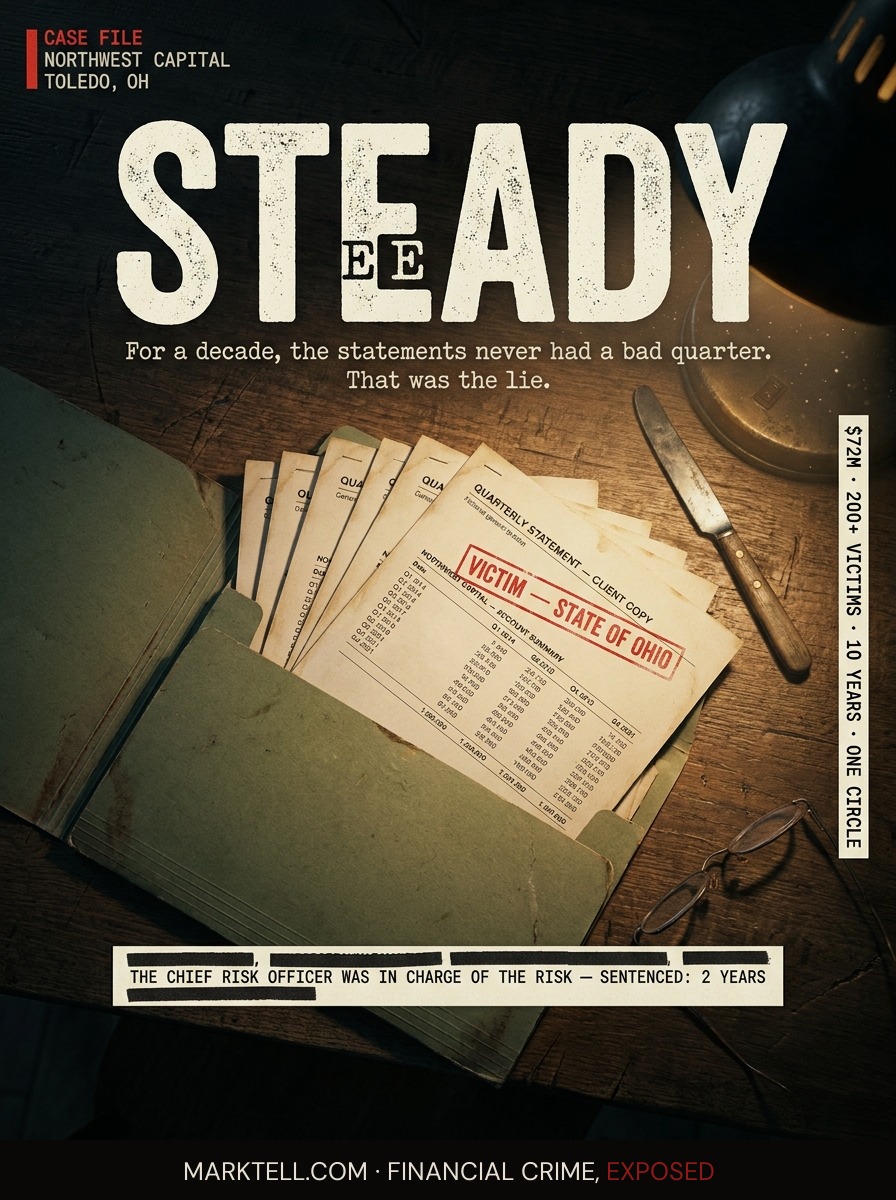
The chief risk officer was in charge of the risk. That was the risk.
For ten years, Northwest Capital in Toledo told two hundred people their money was working. A grand jury in Ohio says it was moving in a circle. This summer, the circle finally opened in a courtroom.
I.
The letter came on a Tuesday. Marlene, seventy-one, retired from twenty-nine years of running payroll for a school district outside Toledo, put it on the kitchen table next to the green accordion folder where she kept the statements. She read it twice. Then she read it a third time, slowly, the way she used to read a benefits election form when a teacher was about to make a mistake.
The letter was from the Ohio Attorney General's office. It said the firm that had been managing her money since 2014 was at the center of a criminal case. It said she was listed as a victim.
She did not cry. She opened the accordion folder.
The statements went back years. Quarterly. Neatly stapled. The numbers on them had grown, slowly, in the way she had been told to expect. Not too fast. That had been part of the pitch. Nothing flashy. Nothing that would get you in trouble. Just steady. Steady was the whole idea.
She looked at the most recent statement. Then she looked at the letter. The numbers on the statement, she now understood, were the story the firm had told her about her money. The letter was the story about what her money had actually been doing.
The two stories did not match.
II. The Circle
The Ohio Attorney General's office calls it a decade-long Ponzi scheme. They say it ran out of a Toledo-based investment firm called Northwest Capital from January 2011 until December 2021. They say it took in around $72M across more than seven hundred investments from at least two hundred people. Individual losses, according to the state, run from $50K to $700K.
The mechanism, described in the indictments and by state investigators, is old. Older than Northwest Capital. Older than any of the people who worked there.
A Ponzi scheme is a circle. New money comes in the front. Old money goes out the back, dressed as returns. As long as more comes in than goes out, the statements look correct. The statements always look correct. That is the point of the statements.
What made this one modern was the wrapper.
Investors were not told they were buying into a circle. They were told they were buying "alternative investments" in accounts receivable. Read that phrase slowly. Accounts receivable is the money a business is owed by its customers but has not yet collected. If you buy someone's receivables at a discount, and the customers pay, you make a return.
That is a real business. Factoring companies do it every day.
The state alleges that Northwest Capital used the shape of that real business as the cover for something else. Investors' money, they say, was routed through a set of interrelated entities. Briarfield Capital. ThunderRoad Partners. TRF Fund 1. TRF Fund 2. Kings Point Leasing. Winding Creek Partners.
Read those names slowly too. Six names is not a portfolio. Six names is a hallway. Money walked down the hallway. At each door, a piece of paper said something had happened. At the end of the hallway, the money was gone, and the papers said everyone had done well.
The underlying companies whose receivables were being sold, according to the state, were significantly impaired. That is a polite word. It means the businesses were failing. It means the receivables were not going to be collected in the amounts described. It means the returns Marlene was seeing on her quarterly statements were not coming from the businesses at all.
They were coming from the next investor.
III. The Chief Risk Officer
On May 19, 2026, John Walters, fifty-four, of Perrysburg, Ohio, was sentenced to two years in prison. He had been the chief risk officer of Northwest Capital.
Sit with that title.
The chief risk officer is the person inside a financial firm whose job is to see the danger before the clients do. He is the one who is supposed to say no. He is the last line between the pitch and the paperwork.
Walters pleaded guilty to one felony count of false statement in the sale of a security and four felony counts of securing writings by deception. The state attributed roughly $9M of the fraud to his conduct. He was the first defendant sentenced in the case.
The pattern that led to his desk had shown up in the record years before. In 2016, FINRA, the industry regulator that oversees brokers, had already barred two men later charged in the Northwest Capital case: Doug Miller and Gary Rathbun. A FINRA bar means an industry body has already decided a person cannot operate as a licensed broker. It is a warning that arrives before the criminal one.
The state alleges the operation continued for another five years after those bars.
That is the part that is hardest to look at directly. The regulators had already spoken. The industry had already crossed the names off the list. And, according to the state, the money kept coming in.
IV. Marlene's Chair
Picture Marlene in her chair. Not the kitchen chair. The other one. The wingback in the front room where she read the statements when they came in the mail.
For years, when a quarterly statement arrived, she would sit in that chair and open it with a butter knife. Her husband had done the same thing before he died. It was a habit that felt like discipline. She would run her finger down the column. She would nod. She would put the statement in the accordion folder.
The pitch that put her in that chair, according to the state, came from advisors she trusted. Northwest Capital, the indictments say, solicited investment advisory clients to purchase these alternative investments without fully disclosing conflicts of interest or the impaired status of the underlying companies.
Say that in English. The people advising her had a reason to sell her these products that they did not tell her about. And the products themselves were not what they were described to be.
Marlene did not fail to read the fine print. There was no fine print that said the machine was a circle. The document that would have told her that was not the offering memorandum. It was the indictment. And the indictment did not arrive in her mailbox for another five years.
V. The Sentencings
The rest of the case has been moving through Ohio courtrooms this spring and summer.
Richard Scheich, the chief operating officer of Northwest Capital, pleaded guilty to five felonies in May 2025 and is cooperating with the state. Doug Miller pleaded guilty in January 2026 to multiple felonies, including theft and securities fraud, and agreed to testify against his co-defendants. Cooperation deals are how prosecutors turn an operation inside out. The people who ran the hallway describe the hallway.
James Delverne, fifty-five, of Toledo, faces seventy-eight felony counts. His sentencing was scheduled for June 29, 2026. Nancy Rathbun, seventy-three, of Wauseon, was scheduled for sentencing on June 30, 2026, alongside Doug Miller. Colleen Hall, Adam Solon, and Brad Konerman have also been indicted on various felony charges. Their matters remain pending.
Gary Rathbun, sixty-eight, Nancy's husband, faced thirty-seven felony counts. In May 2026, as his trial approached, he died by suicide.
That is not a sentence in the case. That is what the record says.
Institutional lenders are trying to recover at least $8M from companies and individuals tied to the scheme. Percent, a private credit lending firm, claims more than $5.2M. Waterford Bank of Toledo is owed more than $2.75M. Their money went into the same hallway.
VI. The Folder
The last time Marlene opened the accordion folder, she took out every statement and laid them across the kitchen table in order. Twelve years of paper.
She noticed something she had not noticed before. The formatting had changed a few times over the years. The logo had been updated. The paper stock had been swapped. In one batch, the columns were slightly narrower.
But the story the statements told, from the first one to the last one, was the same story. Steady growth. Small variations. Never too fast. Never a loss.
That was the tell she could not have been expected to see. Real portfolios have bad quarters. Real receivables get written off. Real markets move. A statement that never has a bad quarter across a decade is not a portfolio. It is a promise. And a promise is not an asset. It is a piece of paper someone typed.
She put the statements back in the folder. She closed the accordion. She did not throw it away. She put it back in the drawer, in the place where she used to keep the good china.
She has not told her son the number yet.
VII.
The Ohio Attorney General's office calls it a Ponzi scheme. That word is old and worn out and true. It describes the geometry of what was allegedly done. A circle dressed as a line.
What is worth saying, at the end, is what the record shows about who was in the room when the circle was drawn. A chief risk officer. A chief operating officer. Registered advisors, two of them already barred by FINRA five years before the alleged scheme ended. A married couple. Employees. A firm with a Toledo address, an office, a website, quarterly statements printed on real paper.
The machinery of legitimacy was the machinery of the fraud. There was no other machinery.
Marlene did not lose her money to a stranger. She lost it, the state alleges, to the exact people the system had built to protect her from strangers.
The chief risk officer was in charge of the risk.
That was the risk.
- WANE 15 | 2026 | "Players in $72M decades-long Ponzi scheme sentenced in Ohio"
- Ohio Attorney General's office | 2025-2026 | Public statements and indictments in State of Ohio v. Walters et al.
- Ohio Department of Commerce, Division of Securities | 2025-2026 | Investigation record and public releases
- FINRA BrokerCheck | 2016 | Bars of Doug Miller and Gary Rathbun
- Ohio court records | May 19, 2026 | Sentencing of John Walters
- Ohio court records | May 2025 | Guilty plea of Richard Scheich
- Ohio court records | January 2026 | Guilty plea of Doug Miller
- Ohio court dockets | June 29-30, 2026 | Scheduled sentencings of James Delverne, Doug Miller, Nancy Rathbun
Editorial Notice
MarkTell is a true crime publication about financial fraud. Some scenes, dialogue, and sequential details are reconstructed from court filings, enforcement actions, news reports, and public records. Where the public record does not provide exact details, editorial reconstruction is used to convey the documented pattern of events. Names of private individuals may be changed to protect identity. All factual claims are sourced to public documents cited in the Evidence Trail above. MarkTell does not provide investment, legal, or financial advice. Nothing published here constitutes a recommendation to buy, sell, or avoid any investment. Allegations described in active cases have not been adjudicated and defendants are presumed innocent until proven guilty. Readers should conduct their own due diligence before making financial decisions.