The call said she had won. The check said she was paying.
Federal prosecutors say six defendants ran a Publishers Clearing House impersonation scheme out of Florida and Virginia, calling elderly Americans, telling them they had won millions, and collecting the "fees" by mail. The indictment landed June 2. The arrests followed within a week.
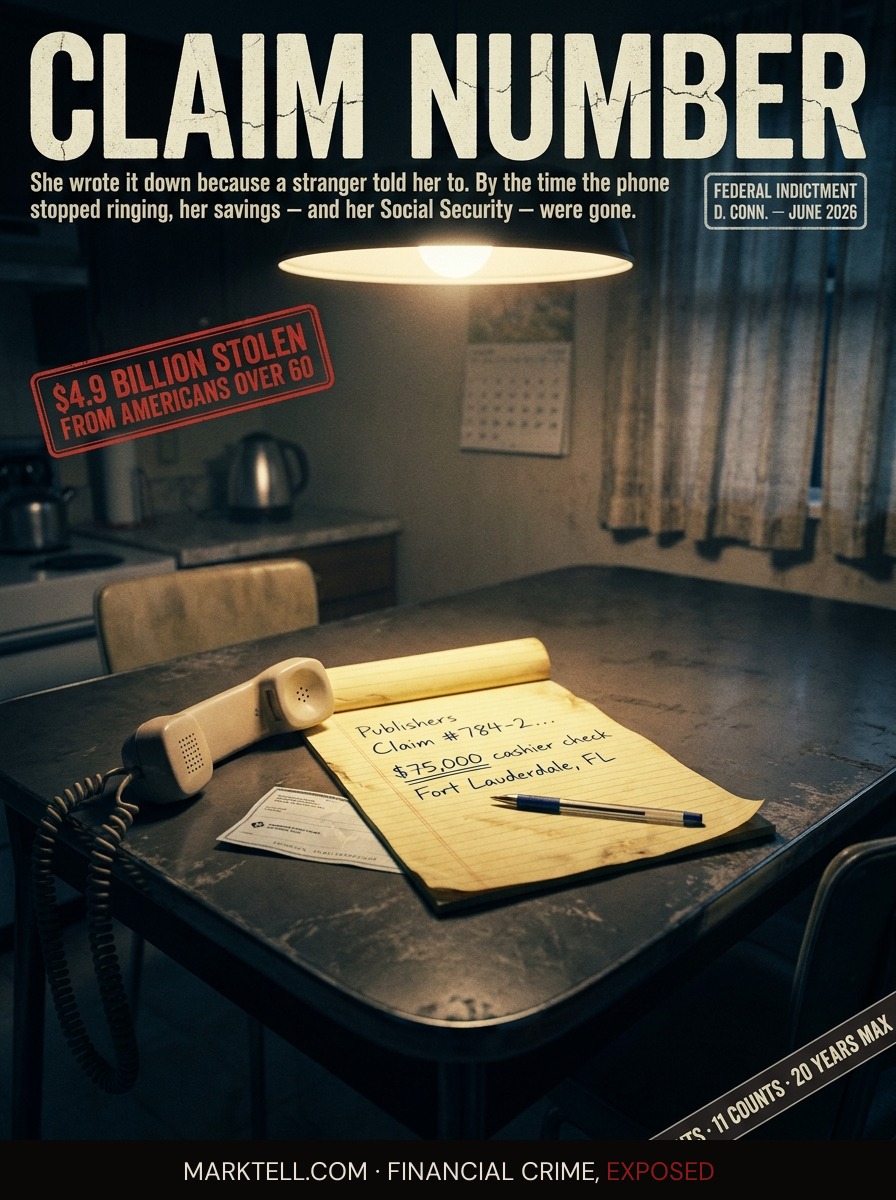
Margaret wrote the number down on a yellow legal pad because that is what she had always done. Forty-one years at the reference desk of a public library teaches you to write things down. The voice on the phone had given her a claim number, six digits, and she repeated it back. The voice said she had it right. The voice said congratulations.
She was seventy-eight. She lived in a small house in Fairfield County that her husband had paid off in 2014 and died in five years later. The phone in her kitchen was a landline because she had never seen a reason to change it. The voice on the other end knew her first name. It used it three times in the first minute.
You have won, the voice said. Publishers Clearing House. Two and a half million dollars.
There was a process, the voice explained. There were taxes. The IRS required them upfront, before the check could be released. A cashier's check made out to a name Margaret wrote on the legal pad. An address in Florida. The voice was patient. The voice did not rush.
Margaret drove to her bank the next morning. The teller did not ask. The check was for seventy-five thousand dollars.
That part may be the saddest.
II. The indictment
On June 2, 2026, a federal grand jury in New Haven returned an indictment against six people. Andre-Jon Gayle, thirty-three, of Fort Lauderdale. Aaliyah Mayne, twenty-five, of Dania, Florida. Onaje Chevers, twenty-nine, also of Dania. Matthew Hutchinson, twenty-four, of Williamsburg, Virginia. Courtney Reynolds, thirty-one, of Miami. Roshaun Thompson, twenty-four, of Fort Lauderdale.
Five are Jamaican citizens. One is a U.S. citizen.
Each is charged with one count of conspiracy to commit mail fraud and wire fraud, five counts of mail fraud, four counts of wire fraud, and one count of conspiracy to commit money laundering. Each count carries a statutory maximum of twenty years. Statutory maximums are ceilings. They are not predictions.
The arrests happened between June 4 and June 10. On Thursday, June 25, four of the defendants appeared in federal court in Bridgeport. Gayle. Hutchinson. Reynolds. Thompson. They pleaded not guilty. They were released on bonds of $250,000 each. Mayne and Chevers remain detained.
Allegation is not adjudication. The defendants are presumed innocent. What follows is what the government says happened.
III. The list
The government says the defendants began with a list.
A list of elderly Americans. Names. Addresses. Phone numbers. Ages. The lists are not free, but they are not expensive either. They are sold on the open market by data brokers and on closed markets by people who do not advertise. In the trade, the people on these lists have a name. The polite term is "lead." The other term is the one nobody uses out loud.
The indictment alleges the defendants purchased these lists and worked them.
The script was Publishers Clearing House. A real company. A name that has been advertising on American television for fifty years. A name your grandmother trusts because she watched the prize patrol arrive at someone's front door with a giant cardboard check in 1989 and she has not had a reason to update that picture since.
You won, the caller said. To collect, you have to pay the taxes.
Legitimate sweepstakes do not work this way. Interim U.S. Attorney David Sullivan said it plainly when the indictment was announced: real sweepstakes winners never need to pay upfront fees or taxes to claim a prize. Never. Not once. Not under any circumstance.
But Margaret did not know that. Margaret knew the company name. Margaret knew her own first name in a stranger's mouth. Margaret had a yellow legal pad and a claim number and a deadline.
IV. The back end
The front end of the machine was the call. The back end was the deposit.
Some victims mailed cashier's checks. Some mailed money orders. Some mailed cash. The indictment alleges the defendants and their associates collected the mail at addresses they controlled in Florida and elsewhere.
Then, in some cases, the machine went deeper.
The indictment alleges that some victims were persuaded to hand over their banking information, their credit card numbers, their Social Security details. The government alleges that the defendants then redirected those victims' monthly Social Security benefits into Green Dot prepaid card accounts the defendants controlled.
A Green Dot card is a prepaid debit card. You can buy one at a drugstore. You can load it with cash. You can use it like a checking account without ever opening a checking account. For the elderly, it can look like just another card. For the people who allegedly built this machine, it was a deposit rail that did not require a teller, an ID check, or a question.
The Social Security check kept arriving every month. It just stopped arriving in Margaret's account.
V. The pattern
The Connecticut case is not the only one.
On Tuesday, June 24, in Hartford federal court, a Jamaican citizen named Jimmy Smith was sentenced to forty-six months in prison for a separate sweepstakes conspiracy. According to court documents, that scheme defrauded victims of more than $2.6 million. Smith pleaded guilty in November 2025.
On the same Thursday the four Connecticut defendants were entering not guilty pleas in Bridgeport, investigators in Manatee County, Florida announced an elder fraud case in which more than forty victims had been identified, with losses exceeding $3.5 million.
On the same Thursday, the New York Attorney General announced the arrest of a man accused of stealing the home and roughly $148,000 in savings from a ninety-two-year-old woman with dementia.
This is one week. One week in June 2026.
The FBI's Internet Crime Complaint Center reported that in 2024, Americans aged sixty and older filed nearly 150,000 fraud complaints. The reported losses totaled approximately $4.9 billion. The average loss per victim was close to $34,000.
Read that slowly. $34,000. Per victim. On average.
The AARP estimates total annual losses for Americans over sixty at $28.3 billion. The Treasury Department's financial crimes unit identified over $27 billion in suspicious activity linked to elder exploitation in a single year of review.
This is not a series of bad luck stories. This is an industry.
VI. The call that did not stop
Margaret got a second call a week later. The voice said the IRS needed more. There was a state tax. There was a processing fee. There was a customs charge because the check was being sent from a Canadian fulfillment center.
She sent another check. She sent a third.
When her daughter called on a Sunday and asked how she was doing, Margaret said fine. The yellow legal pad was in the drawer by then. Underneath the bills. Margaret was a librarian. She knew how to file something where it would not be found.
The realization, when it came, did not come as a phone call or a letter. It came as silence. The voice stopped calling. The check did not arrive. The claim number was not a claim number. It was just six digits she had written down because a stranger had asked her to write them down.
She did not tell her daughter for four months.
The indictment does not name Margaret. Margaret is a composite, drawn from the patterns the prosecutors describe and the Connecticut victim whose July 2022 contact and $75,000 check appear in the related case record. But somewhere in the discovery file in New Haven there is a real Margaret. There is more than one.
VII. What the indictment is and is not
The indictment is a charging document. It is not a verdict. The defendants have entered not guilty pleas. They are entitled to a trial. They are presumed innocent.
What is true regardless of the outcome of that trial is this. Somewhere in Connecticut, a woman wrote a number on a legal pad. Somewhere in Connecticut, a woman drove to her bank and asked the teller for a cashier's check and the teller did not ask why. Somewhere in Connecticut, a woman waited for a prize that was never going to come.
The U.S. Postal Inspection Service is investigating. So is IRS Criminal Investigation. So are the U.S. Marshals. The case is being prosecuted out of the District of Connecticut.
The defendants face up to twenty years on each of the most serious counts if convicted. That is the ceiling. The actual sentence, if there is one, will be set by a judge after a verdict, after a sentencing hearing, after a presentence report.
But the machine that the indictment describes does not need a verdict to keep running. The machine is the list. The machine is the script. The machine is the prepaid card. The machine is the patience to call a thousand Margarets to find the one who picks up.
The six defendants charged in New Haven are not the machine. They are alleged operators of one node of it.
Tomorrow morning, somewhere in America, a phone is going to ring in a kitchen with a yellow legal pad on the counter. The voice will be warm. The voice will know the name.
That is the part the indictment cannot fix.
- U.S. Attorney's Office, District of Connecticut | June 2026 | Indictment announcement, U.S. v. Gayle et al.
- U.S. District Court, New Haven | June 2, 2026 | Sealed indictment returned by federal grand jury
- U.S. District Court, Bridgeport | June 25, 2026 | Initial appearances and not guilty pleas
- U.S. Attorney's Office, District of Connecticut | June 24, 2026 | Sentencing of Jimmy Smith, 46 months
- FBI Internet Crime Complaint Center (IC3) | 2024 Elder Fraud Report | Aggregate loss figures
- AARP | Elder Fraud Estimates | Annual loss data
- FinCEN | Elder Financial Exploitation Review | Suspicious activity totals
- Manatee County Sheriff's Office | June 25, 2026 | Elder fraud arrests, Xin Liu sentencing
- Office of New York Attorney General Letitia James | June 25, 2026 | Mark Salkey arrest announcement
- CT Insider | June 25, 2026 | Original reporting on the six-defendant indictment
Editorial Notice
MarkTell is a true crime publication about financial fraud. Some scenes, dialogue, and sequential details are reconstructed from court filings, enforcement actions, news reports, and public records. Where the public record does not provide exact details, editorial reconstruction is used to convey the documented pattern of events. Names of private individuals may be changed to protect identity. All factual claims are sourced to public documents cited in the Evidence Trail above. MarkTell does not provide investment, legal, or financial advice. Nothing published here constitutes a recommendation to buy, sell, or avoid any investment. Allegations described in active cases have not been adjudicated and defendants are presumed innocent until proven guilty. Readers should conduct their own due diligence before making financial decisions.