The application looked clean. The business behind it did not exist the way he said it did.
Phillip Collins of Robeson County, North Carolina pleaded guilty on June 29 to wire fraud conspiracy in a COVID-era SBA loan scheme. The pattern is small, ordinary, and still running through other names.
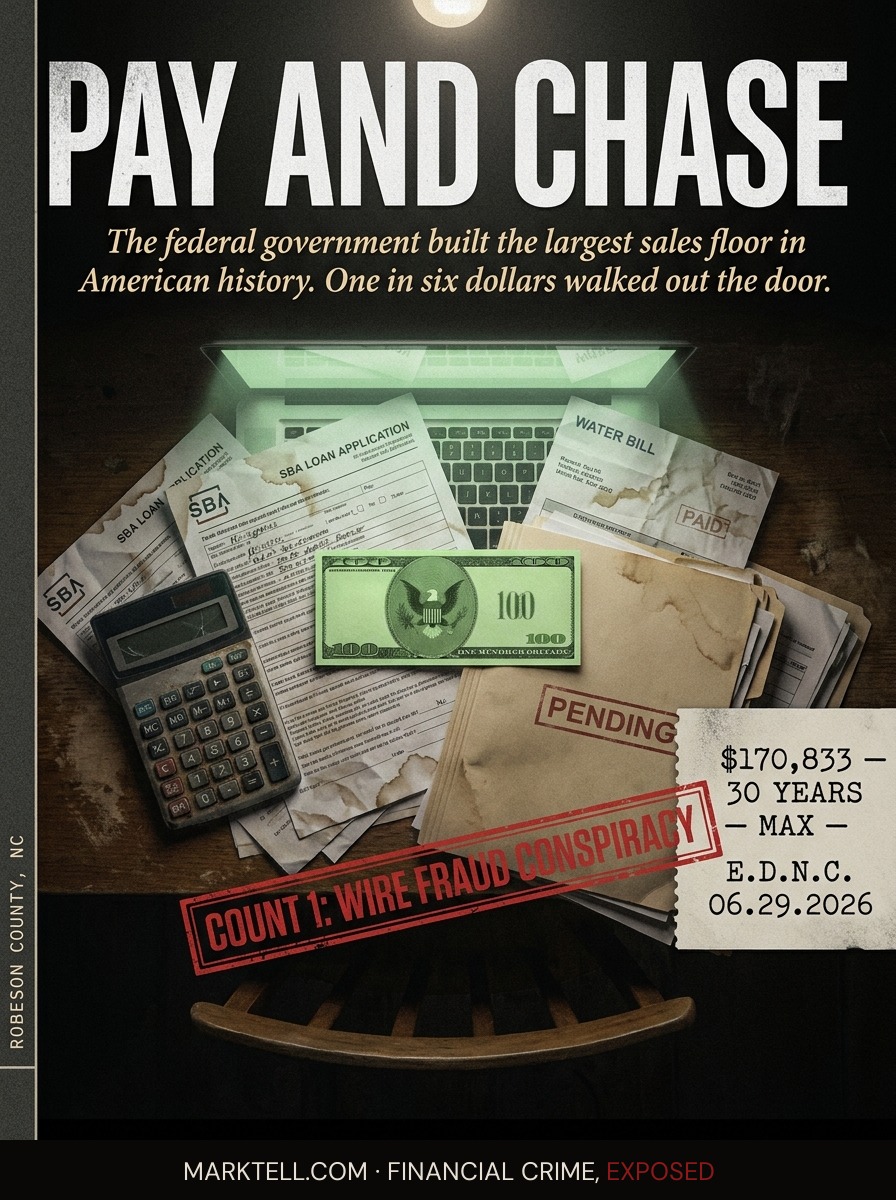
Doreen sat at her kitchen table in Lumberton in the spring of 2020 with a stack of quarterly tax forms and a calculator whose seven key stuck. She was sixty-two. She had managed a school cafeteria for nineteen years. The school was closed. She was trying to fill out a Paycheck Protection Program application for the small catering side business she ran out of the church kitchen on weekends.
She did not understand what an average monthly payroll meant for a person who paid herself in cash some months and not at all in others. She called the bank. The bank told her to call the SBA. The SBA's line was busy for three days.
She filed anyway. She got denied. She filed again. Denied. She filed a third time in June and a deposit cleared for a number smaller than what she had asked for. She cried at the table. Then she paid her water bill and went back to waiting for the school to reopen.
I am telling you about Doreen because the federal courtroom in Raleigh last Monday was about her, even though her name was not on the docket.
The name on the docket was Phillip Collins. Forty-seven years old. Robeson County. He stood in front of U.S. Magistrate Judge Robert Jones on June 29, 2026 and pleaded guilty to one count of conspiracy to commit wire fraud. The amount, according to the U.S. Attorney's office for the Eastern District of North Carolina, was $170,833. The maximum exposure is thirty years and a $1M fine. The forfeiture money judgment matches the take.
That is the news. Now I want to show you the machine.
I.
The machine had a name in 2020. It was called the pay-and-chase window. That is what the people inside the federal program called it among themselves. The Economic Injury Disaster Loan program, EIDL, and the Paycheck Protection Program, PPP, were built to push money out the door fast. The door was wide. The verification was built to happen later. Pay first. Chase later.
The honor system worked for the honest. It worked even better for everyone else.
According to the plea, Collins submitted EIDL and PPP applications for a business in Robeson County. The applications said the business had more employees than it had. They said the business had more revenue than it had. They were supported by tax forms that were not real and bank statements that were not real. When the loans cleared, the money was wired into a personal account he controlled.
That is the whole machine. Misrepresent the business. Fabricate the documents. Receive the wire. Spend the wire.
Read that slowly. There is no innovation in it. There is no clever turn. There is a man filling out forms with numbers he made up, attaching PDFs that look like tax forms, and clicking submit while somewhere else a cafeteria manager is on hold with the SBA.
II.
The SBA Office of Inspector General estimated in June 2023 that more than $200 billion in potentially fraudulent COVID-19 EIDL and PPP loans were disbursed. At least seventeen percent of all funds. One in six dollars.
Picture that. The largest emergency small-business program in American history, and one in every six dollars went somewhere it was not supposed to go.
The $170,833 in the Collins case is a single grain in that pile. The case matters because the grain is the unit. The machine only ever worked one application at a time.
Look at June 2026 alone in the federal docket. On June 12, the Department of Justice announced coordinated arrests and indictments of seven men in three states for fraudulent PPP and EIDL applications totaling $205,639. On June 24, eight North Carolina tax return preparers pleaded guilty in a pandemic-relief fraud scheme involving almost $25 million. On June 25, a Lenoir County Social Services employee was sentenced for stealing over $100,000 from SNAP benefits. On June 29, in the same week as Collins, a director in Wolverhampton in the United Kingdom was sentenced for fraudulently claiming £30,000 (about $38K USD) in Covid Bounce Back Loans.
And earlier this year, in March 2026, a former Robeson County Sheriff's deputy named Ricky McMillian pleaded guilty along with his wife and two sons to stealing over $542,000 in fraudulent COVID loans through the same EIDL and PPP programs. His wife Erica was sentenced to ten months in April for her role in obtaining a $150,000 EIDL for a fictitious business.
Same county. Same programs. Same method. Different family.
That is not a coincidence. That is a pattern leaving fingerprints in a single rural county six years after the window closed.
III.
I want you to picture the room where the application was approved. There was no room. That is the point. There was a server. There was a queue. There was an algorithm that scored applications against thresholds. A human being looked at some of them. A human being did not look at most of them.
The pitch from the federal government to the applicant was simple. Tell us about your business. Tell us how many employees. Tell us your gross revenue. Attach your tax forms. Attach your bank statements. We will get you the money fast.
The pitch worked on Doreen. The pitch also worked on Phillip Collins. The difference was that Doreen attached real documents and Collins, according to his plea, attached false ones.
The system could not tell the difference at the speed it was running. That is not editorial. That is the SBA Inspector General's own finding.
I spent forty years selling things over the phone. Metals. Timeshares. Magazine subscriptions. Small-cap shares in a blimp company that did not make blimps. The first rule of any sales floor is that the speed of the close matters more than the accuracy of the qualification. If you slow down to verify, you lose the deal. If you don't, you book the deal and let somebody else worry about whether it was real.
The federal government, in 2020, built the largest sales floor in American history. They booked the deals. Now somebody else is worrying about whether they were real. That somebody else is the U.S. Attorney's office. The chase part of pay-and-chase.
The statute of limitations for PPP and EIDL fraud was extended to ten years. The DOJ's COVID-19 Fraud Enforcement Task Force, established in May 2021, has brought charges against more than 1,000 defendants. The Western District of North Carolina alone has secured almost $18 million in judgments and collected over $5.5 million in assets.
Six years in, the chase has years left to run.
IV.
Doreen got her smaller-than-asked-for deposit in June 2020. She paid the water bill. She paid the church for the use of the kitchen. She kept the catering side business alive through 2021 by doing two graduations and a funeral. She did not commit a crime.
She also paid federal income tax in 2021 on the portion of her unemployment that was taxable, because she did not know there was a way to ask for it back, and her tax preparer did not tell her.
Somewhere in the same county, according to the plea entered last Monday, a man received $170,833 in a personal account by filing paperwork that said his business was bigger than it was.
That is the part that may be the saddest. The honest applicant got less than she needed and paid taxes she did not have to. The dishonest applicant got the full ask, in a personal account, and is now facing thirty years.
Both of them were processed by the same machine.
V.
U.S. Attorney W. Ellis Boyle made a statement after the plea. He said: "Although the government may have stopped doling out Covid money, our government continues to hand out billions in other loans, subsidies, and programs. This office will continue to hold accountable anyone who defrauds any of our taxpayer funded programs. Crime Doesn't Pay! Cheaters. Never. Win."
I want you to read the first sentence of that statement again. The government continues to hand out billions in other loans, subsidies, and programs.
That is the part that is not about Phillip Collins.
The COVID programs are closed. The pay-and-chase window for that specific emergency is shut. But the architecture is not. The architecture is the architecture of any emergency federal disbursement program built to move money fast. The next hurricane. The next pandemic. The next industry bailout. The next infrastructure rollout.
The machine that paid Collins did not die when the program ended. It was retired. It will be rebuilt under another name, the next time speed matters more than verification, and the queue will reopen, and the applications will come in, and most of them will be from Doreens, and some of them will not.
The plea was entered on June 29, 2026. Sentencing is scheduled for later this year. The forfeiture money judgment is $170,833. The chase, in this one small case in one small county, caught up.
The window is closed. The architecture remains.
That is the chapter. The next one is already being built.
- The Robesonian, Lumberton NC | June 29, 2026 | "Pembroke man pleads guilty to stealing over $170,000 in Covid loans"
- U.S. Attorney's Office, Eastern District of North Carolina | June 29, 2026 | Plea announcement and statement of U.S. Attorney W. Ellis Boyle
- SBA Office of Inspector General | June 2023 | Report on COVID-19 EIDL and PPP fraud estimates
- U.S. Department of Justice, COVID-19 Fraud Enforcement Task Force | est. May 2021 | Enforcement statistics through 2026
- DOJ press release | June 12, 2026 | Coordinated arrests, seven defendants, $205,639 PPP/EIDL fraud
- DOJ / U.S. Attorney (NC) | June 24, 2026 | Eight North Carolina tax return preparers, ~$25M pandemic-relief fraud plea
- DOJ / U.S. Attorney (EDNC) | June 25, 2026 | Lenoir County DSS employee SNAP fraud sentencing
- DOJ / U.S. Attorney (EDNC) | March 2026 | Ricky McMillian family plea, $542,000 COVID loan fraud
- DOJ / U.S. Attorney (EDNC) | April 2026 | Erica McMillian sentencing, $150,000 EIDL for fictitious business
- UK Insolvency Service | June 29, 2026 | Wolverhampton director Bounce Back Loan fraud sentencing
- U.S. Attorney's Office, Western District of North Carolina | 2024-2026 | Aggregate COVID fraud recovery statistics
Editorial Notice
MarkTell is a true crime publication about financial fraud. Some scenes, dialogue, and sequential details are reconstructed from court filings, enforcement actions, news reports, and public records. Where the public record does not provide exact details, editorial reconstruction is used to convey the documented pattern of events. Names of private individuals may be changed to protect identity. All factual claims are sourced to public documents cited in the Evidence Trail above. MarkTell does not provide investment, legal, or financial advice. Nothing published here constitutes a recommendation to buy, sell, or avoid any investment. Allegations described in active cases have not been adjudicated and defendants are presumed innocent until proven guilty. Readers should conduct their own due diligence before making financial decisions.