The address change form was the part that finally caught him.
Hu Shi, the alleged second-in-command of Cambodia's Prince Group, was arrested in Japan this month. The charge was paperwork. The machine behind him moved $15 billion in stolen Bitcoin and ran on trafficked labor.
I.
Marisol was awake before her alarm. She always was now. The phone was already in her hand by the time her feet touched the cold tile of the bathroom floor, the screen lit green with the trading dashboard she had been watching for fourteen months.
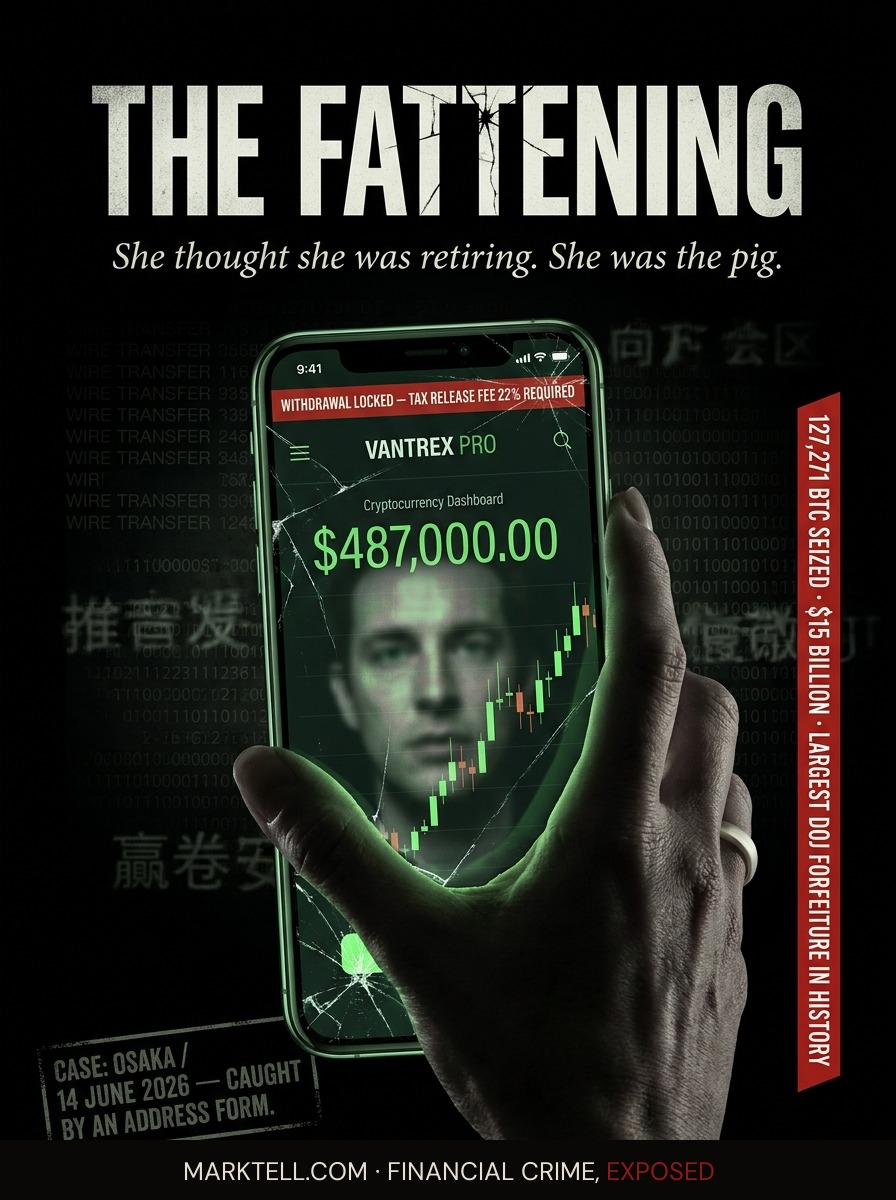
The balance read $487,000.
It had been $312,000 in March. It had been $94,000 the previous October, when she had finally agreed to move money from her credit union into the platform Marco recommended. Marco was a structural engineer who lived in Singapore, or said he did. They had met on a language-exchange app where she was practicing her Mandarin and he was practicing his Spanish. He had been kind in a way her ex-husband had never been. He had remembered things. Her mother's name. The dentist's office where she worked. The street her daughter lived on in Reno.
She was 52 years old. She had not planned to fall in love with a stranger on the internet. She had planned to retire.
The withdrawal screen was where the morning broke. She had requested $40,000 the night before. To pay for her mother's headstone. To send something to her daughter. The screen now asked for a tax release fee. Twenty-two percent. Wired separately. Before the funds would unlock.
Her hands were not shaking. That part came later.
II.
The man whose paperwork they would find in Osaka had nothing to do with Marisol's account. He had never spoken to her. He had never seen her name. He did not need to. The machine he allegedly helped run was designed so that the people at the top did not have to look at the people at the bottom. That was the whole architecture.
Hu Shi, also known as Hu Xiaowei, also known as Chen Xiao'er, was arrested by the Tokyo Metropolitan Police on June 14, 2026, in Osaka. He is 44. He holds Cypriot citizenship. The immediate charge was almost embarrassing in its smallness: he had allegedly filed a false address change form in April 2026, claiming residency at a Tokyo apartment he had never occupied, in order to obtain Japanese permanent residency. Two Chinese nationals were arrested alongside him for allegedly handling the paperwork on his behalf.
That is the charge. That is the part that finally caught him.
The allegations behind the charge are larger. The U.S. Department of Justice and the U.S. Treasury allege that Hu Shi is a senior executive of the Prince Group, a Cambodia-based conglomerate that OFAC sanctioned in October 2025 as a Transnational Criminal Organization. The DOJ filed a civil forfeiture action that same month for 127,271 Bitcoin, valued at roughly $15 billion at the time of the filing. It was the largest forfeiture action in DOJ history. The UK Treasury followed with its own sanctions and froze $134 million in London real estate. Hu Xiaowei was specifically named by UK authorities in March 2026.
In an April 23, 2026 interview, Hu Shi denied being a leader of the group. Prince Group has denied wrongdoing through U.S. counsel. Allegation is not adjudication. Hold both of those things at the same time as you read what comes next.
III.
The machine has a name. Two names, actually.
The polite name is "investment fraud." The accurate name, the one used inside the compounds where the scripts are written and the keyboards are guarded, is sha zhu pan. Pig butchering. You fatten the pig before you slaughter it.
The fattening is the part Marisol lived inside. The fourteen months of messages. The photos of Marco's apartment that were stolen from a Korean influencer's Instagram. The voice notes that came from a man who was not Marco at all but a trafficked worker in a fenced compound in Sihanoukville or Bavet, reading a script, switching to the next victim after his shift ended. The U.S. State Department and multiple journalistic investigations have documented this. The people sending the messages are themselves prisoners. They are beaten if their numbers fall. The fraud is run on forced labor.
The slaughter is the withdrawal screen. The tax release fee. The second tax release fee. The compliance hold. The lawyer who needs to be paid before the funds can be moved. Each layer is a new wire. Each wire vanishes into mule accounts, then into crypto exchanges, then into mixers, then into wallets controlled by people Marisol will never meet.
By the time the money reaches the top of the structure, where Prince Group allegedly sat, it is clean. It looks like real estate revenue. It looks like a casino's quarterly take. It looks like a holding company's investment income. That is the architecture. That is what the DOJ alleges Chen Zhi built and what Hu Shi allegedly helped run.
I want to be clear about something, because I worked in this industry on the other side of the wall. The technical part of this fraud is not sophisticated. The smart contracts are not elegant. There is no novel cryptography. The "trading platform" Marisol watched is a website with a database. The numbers that went up were numbers in a database somebody at a desk could change. The platform did not exist as a market. It existed as a screen.
The sophistication is upstream. It is in the human pipeline. It is in the compound. It is in the way the script was written so that Marco asked about Marisol's mother before he ever mentioned money. It is in the way the platform was made to look like a Bloomberg terminal so that a dental hygienist who had never traded anything in her life could feel like a sophisticated investor. The code was the cheapest part. The lie was the expensive part.
IV.
Marisol wired the 22% fee.
She did it because Marco told her, on a video call where his face was actually a deepfake layered over the trafficked worker's, that he would cover half. He said he was wiring his share that day. He said he loved her. He said her mother would have a beautiful headstone.
The fee cleared. The withdrawal did not.
A new screen appeared. A compliance review. Another fee. The number was larger this time. She did not have it. She borrowed against the house. Her daughter found out two weeks later, when the second mortgage paperwork arrived at the Reno address by mistake.
The conversation in the kitchen was the worst hour of Marisol's life. Her daughter was not angry. That was somehow worse. Her daughter was the one who said the words out loud. Marisol had not let herself say them. The platform was not real. Marco was not real. The money was gone.
Not down. Gone.
V.
There is a thing I want to name about the Hu Shi arrest, because the smallness of the charge matters.
He was not arrested for the $15 billion. He was not arrested for the compounds. He was not arrested for the trafficking. He was arrested for a falsified address change form. A piece of paperwork claiming he lived in a Tokyo apartment he did not live in.
A Tokyo-headquartered company he led, according to Japanese reporting, saw its registered capital climb from ¥8 million (about $50K USD) to ¥50 million (about $320K USD) by March 2026. That is the visible piece. That is the legitimate-looking front. The address form was the seam where the machine showed through. He needed Japanese residency. He filed paperwork. The paperwork was false. The police followed the paperwork.
This is how these arrests almost always happen. Not because the prosecutors finally cracked the on-chain forensics. Not because someone inside the compound talked. Because the operator tried to live a normal life in a country with a functioning bureaucracy, and the bureaucracy noticed something small.
Chen Zhi, the alleged founder, was arrested in Cambodia and extradited to China in January 2026. Li Xiong, the former chairman of the affiliated Huione Group, was extradited to China in April 2026. The crackdown is real. It is global. It is also incomplete. A report on June 21, 2026 described thousands of trafficked workers stranded in Cambodia after their compounds shut down, with nowhere to go and no documents to leave.
The machine got hit. The machine did not stop.
VI.
Americans lost at least $10 billion to Southeast Asia-based scam operations in 2024, according to estimates cited in the public record. That number was 66% higher than the year before. Read that slowly. The losses are accelerating, not declining, even as the enforcement intensifies. The reason is structural. The compounds can be moved. The scripts can be rewritten. The trafficked workers can be replaced. The platforms can be spun up in a weekend. The only scarce resource in this machine is the victim, and there are always more victims.
Marisol does not know who Hu Shi is. She read about the arrest because a friend sent her a link. She does not know if any of the 127,271 Bitcoin in the DOJ forfeiture action ever passed through the wallets that held her money. Most victims will never know. Victim advocates have raised concerns about whether seized funds will be returned at all, or whether they will be absorbed into government reserves.
She is back at the dentist's office now. She kept the job. She lost the house. Her mother's headstone is plain granite, paid for by her daughter and her brother. The phone she stares at in the morning is a new one. She does not use language-exchange apps anymore. She does not use any apps where strangers can message her. She told me, when I asked, that the part she cannot stop thinking about is not the money.
It is that for fourteen months, she had felt seen.
VII.
The headline of this story is that an alleged kingpin was arrested in Japan. The actual story is that the charge was paperwork.
The machine is not a man. The man was a node. There are other nodes. The compound that ran Marco's account is probably still running, or has been rebuilt under a new corporate wrapper in a different jurisdiction, with the same scripts and the same trafficked workers and the same database that pretends to be a market. The next Marisol is being messaged right now. She is practicing a language. She is widowed, or divorced, or just lonely on a Tuesday night. The script has her name in it already.
He thought he was hiding behind a Tokyo address.
She thought she was building a future with an engineer in Singapore.
Only one of them was right about who was watching.
- Cryptonews.net | June 2026 | Source article on Hu Shi arrest
- U.S. Department of Justice | October 2025 | Civil forfeiture action for 127,271 BTC tied to Prince Group / Chen Zhi indictment
- U.S. Treasury OFAC | October 2025 | Sanctions designation of Prince Group and 146 affiliated entities as TCO
- UK HM Treasury | October 2025 and March 2026 | Sanctions including specific designation of Hu Xiaowei and £-denominated property freeze
- Tokyo Metropolitan Police Department | June 14, 2026 | Arrest of Hu Shi on suspicion of falsifying public records
- Hu Shi interview | April 23, 2026 | Denial of leadership role in Prince Group
- U.S. State Department and multiple investigative outlets | 2023-2026 | Documentation of forced-labor scam compounds in Cambodia and Myanmar
- Public reporting | June 21, 2026 | Stranded trafficked workers in Cambodia post-crackdown
- FBI public statements | June 2026 | Director Patel remarks on crypto crime enforcement
Editorial Notice
MarkTell is a true crime publication about financial fraud. Some scenes, dialogue, and sequential details are reconstructed from court filings, enforcement actions, news reports, and public records. Where the public record does not provide exact details, editorial reconstruction is used to convey the documented pattern of events. Names of private individuals may be changed to protect identity. All factual claims are sourced to public documents cited in the Evidence Trail above. MarkTell does not provide investment, legal, or financial advice. Nothing published here constitutes a recommendation to buy, sell, or avoid any investment. Allegations described in active cases have not been adjudicated and defendants are presumed innocent until proven guilty. Readers should conduct their own due diligence before making financial decisions.