Sixteen Australians, two weeks, $2.7 million. The tip came through a friend.
ASIC warned this week that a new wave of pump and dump scams is moving through Australian phones, wearing the faces of trusted economists and running through group chats that feel like a favor from a friend. Sixteen people learned what the favor cost.
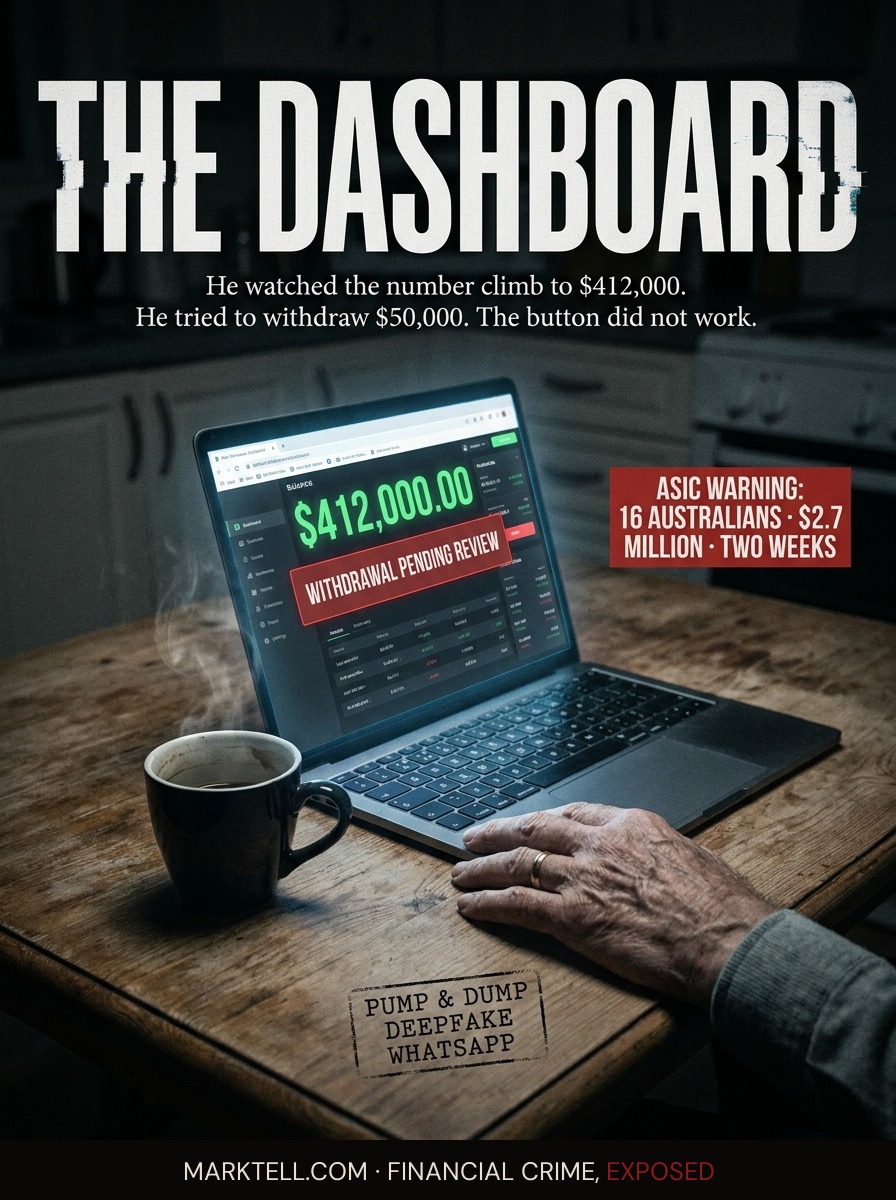
The mug was still warm. Tony had made the instant coffee at 6:15, the same way he had made it every morning since he stopped working on trucks. Two spoons. Boiling water. Milk from the fridge that his wife used to buy and that he now bought himself.
The laptop was open on the kitchen table because that was where the light was good. The business segment was playing on the TV in the next room. He half-listened. He was seventy-four and he had watched enough business segments to know that most of them were noise and once in a while there was something.
The ad came up on Facebook while he was scrolling. It had the Commonwealth Bank logo in the corner. It had the face of a man he recognized from the ABC. Tom Piotrowski. The economist. Tony had watched him talk about interest rates for years. He liked him. He seemed steady.
The man in the ad was talking about a stock. He was saying that a small group of Australians were being let in on something early. He was saying it the way he said everything, calm and clear, like a doctor telling you what the results meant.
Tony clicked.
That is the moment. That is where the door was.
He filled in a form. His name. His email. His phone number. Within an hour a woman named Emma sent him a message on WhatsApp. She was polite. She apologized for the direct approach. She said she worked with the analyst group and she was adding him to the members' channel so he could see the daily calls.
The channel had two hundred people in it.
They were talking to each other. Sharing screenshots. One of them had just made forty thousand dollars on a call from last week. Another one was asking Emma when the next entry point was. Emma was answering everyone. She was professional. She used their first names.
Tony read the channel for two days before he did anything. That part matters. He was not reckless. He was cautious. He watched. He wanted to be sure.
That is how the machine was designed. It was designed for a man who watched first.
I.
Here is what regulators say happened, sixteen times, in two weeks.
The Australian Securities and Investments Commission issued a warning on July 16 and 17 of this week. Sixteen Australians lost more than $2.7 million (about $1.8M USD at current rates) to what ASIC is calling a coordinated pump and dump operation running through social media ads and encrypted group chats. Commissioner Alan Kirkland said AI is "supercharging" the sophistication of these schemes. Chair Sarah Court said they are getting harder to detect.
A pump and dump is one of the oldest games in the room. You do not need to understand markets to understand it. You need to understand a card trick.
The operator buys a thinly traded stock at a low price. Thinly traded means almost nobody is buying or selling it, so a small amount of buying can move the price a lot. Then the operator brings in a crowd. The crowd buys. The price goes up. The operator sells into the crowd's buying. The price collapses. The crowd is left holding shares worth a fraction of what they paid.
ASIC described one recent example where the share price ran up to about $15.70 and then dropped to about $1.40. That is roughly a ninety-one percent loss for anyone who bought near the top.
The mechanism is not new. What is new is the wrapper.
II.
The wrapper is the part that matters.
Twenty years ago a pump and dump came through a phone call from a boiler room. A guy with a script taped to his desk. He read the pitch. You said yes or no. If you said yes he sent you a confirmation and a follow-up.
I know how that room worked because I sat in one of them. Not this exact one. A metals room. Same architecture. A hundred desks. A hundred phones. A hundred guys reading from paper. The customer on the other end of the line thought he was talking to a broker. He was talking to a closer who had been told to hit a number by lunch.
The new room does not have desks. It has a dashboard. It has a WhatsApp group. It has an ad on Facebook with the logo of a bank on it and the face of a man you have seen on television.
The face is the innovation.
The face is not real. It is what AI people call a deepfake. A short video generated by software that has been trained on the actual man's actual face and actual voice. The result is close enough that a seventy-four-year-old man drinking coffee at his kitchen table does not question it. Why would he. He has seen that face for a decade.
Tom Piotrowski did not endorse this stock. Scott Pape did not either. Andrew Forrest has been fighting these deepfake videos in Australian courts for two years. The faces are hijacked. The men are furious. The ads keep running.
ASIC's warning names the technique. The National Anti-Scam Centre has been logging the reports. In 2025, Australians lost $837.7 million (about $555M USD) to investment scams alone, part of $2.18 billion (about $1.44B USD) across all scam categories.
Read that slowly. Investment scams were the biggest single category.
III.
Back at the kitchen table.
On the third day, Tony sent Emma a message. He said he was interested. He said he could put in twenty thousand to start. Emma said that was smart. She said many members started small. She sent him a link to the trading platform.
The platform was slick. It had a login. It had a dashboard. It had charts that moved in real time. It looked like the trading apps his son used on his phone. It had the logo of a firm he had never heard of, but the site had the year of establishment and a Sydney address and a support chat that answered within a minute.
He wired twenty thousand.
The dashboard updated within a few hours. His position was showing a small gain already. Emma congratulated him in the group. Two other members welcomed him.
By the end of the first week the dashboard showed his twenty thousand had become twenty-eight thousand. Emma said there was a bigger entry point coming. She said members who wanted to add funds should do so by Friday.
He added sixty thousand.
The dashboard climbed.
By the end of the second week the dashboard said his account was worth $412,000. He had, on paper, quadrupled his money. He had put in $320,000 in total, most of it from the offset account against his mortgage, which he had spent thirty years paying down and which was supposed to stay in the family.
He tried to withdraw fifty thousand.
The button did not work.
He tried again. He got a message saying the withdrawal was pending review. He messaged Emma. She replied within a few minutes, calm as ever, and said the compliance department was doing a routine check because it was his first withdrawal. She said it would take two to three days.
Two to three days is the standard answer. It is the answer the timeshare rooms used when the customer wanted to cancel. It is the answer the metals rooms used when the customer wanted to see a certificate. It is the answer the phone room I worked in used when the customer wanted to talk to a manager. It buys time. Time is the operator's most valuable asset because time lets the operator move the money.
By day three the money had moved.
IV.
The trading platform did not exist as a platform. Not really. It was a website with a database behind it. The numbers on the dashboard were numbers a technician had typed into the database. When Tony deposited money it did not go into any trading account. It went into a bank account controlled by the operators, and from there through a series of transfers designed to make recovery difficult.
There was no stock position in his name. There never was.
The stock was real. The price movement was real. The pump was real. The people in the WhatsApp group buying and pushing were partly real, partly not. Some were actual retail investors pulled in the same way Tony was pulled in. Some were operators posting under multiple names to create the sense of a crowd. This is called sockpuppeting. It is not new. It used to be done with pen names in newsletter mailings. Now it is done with WhatsApp accounts.
When Tony's dashboard showed him a $412,000 balance, the actual money he had wired was already gone. What he was looking at was a screen. A screen the operators controlled. A number they had typed.
He was not a shareholder. He was not an investor. He was a deposit.
That is the reversal. Read it again.
He was not a shareholder. He was a deposit.
V.
On the morning of the fifth day Emma stopped answering.
The group chat had gone quiet the day before. Tony had noticed but had not thought about it. He assumed a weekend was coming. The messages he sent to Emma showed one grey tick, then two grey ticks, then two grey ticks that never turned blue.
He called his son at eleven that night. His son drove over. They sat at the kitchen table with the laptop between them. The son opened the platform. It still loaded. The dashboard still showed the number. The withdrawal button still said pending review.
The son opened another browser and searched for the firm's name and the word scam. The results filled the screen.
Tony did not cry. He did not say much. He got up and made another coffee at half past midnight because it was what he did when he needed his hands to be doing something.
The son called the bank at 6 AM. The bank said the transfers had cleared. The bank said they would open a case. The bank said the recovery rate on these transfers, when the money had already moved offshore, was in the low single digits.
He filed a report with the National Anti-Scam Centre. His name went into the count. He became one of the sixteen.
VI.
The room I used to work in had a phrase for the customer who called back asking for their money.
They called them "the ones who woke up."
The guys in the room did not treat them cruelly. They treated them with a kind of tired procedural politeness, because the guys in the room knew that most of them, once they woke up, would not do anything. Would not sue. Would not press charges. Would be too embarrassed to tell their families. Would eat the loss in silence and keep it inside.
That was the machine's real defense. Not the offshore accounts. Not the fake platforms. The silence of the mark.
ASIC is trying to break that silence. The National Anti-Scam Centre is trying to break that silence. Every article that names the number and the mechanism is trying to break that silence.
But the machine is still running. It is running today, on Facebook, on WhatsApp, on Instagram, with the face of a man you have seen on television saying words he never said, about a stock that is about to move because a room full of operators is about to move it.
Sixteen people. Two weeks. $2.7 million.
That is one operation. In one country. In one two-week window.
VII.
Tony still watches the business segment in the morning. He still drinks the instant coffee. He does not go on Facebook anymore. The laptop sits on the kitchen table but he does not open it much.
The house is still his. He was able to keep the house. His son is helping him with the offset account. He will work through it. He is seventy-four and he does not have the years he had at fifty, and the money that was supposed to be a cushion is gone, and the man on the screen who took it from him will never be found because he was never a man. He was a piece of software rendering a face.
That part may be the saddest.
Not that Tony lost the money. People lose money. Money is money.
But the face he trusted was not a face. And the friend who added him to the group was not a friend. And the dashboard that showed him getting richer was a screen. And the room he thought he had walked into was a room built for him and for fifteen other people just like him, and when the room had taken what it needed the room was folded up and moved and set up again somewhere else, under a new name, with a new face, running the same machine.
The tip came through a friend. The friend was software. The stock was real. The money is gone.
- Australian Securities and Investments Commission (ASIC) | July 16-17, 2026 | Public warning on pump and dump scams using AI deepfakes
- Australian Competition and Consumer Commission (ACCC) Targeting Scams Report | March 30, 2026 | 2025 scam loss statistics
- National Anti-Scam Centre | 2025-2026 | Consolidated scam data
- SBS News | July 16, 2026 | "Sixteen Australians lost $2.7 million in two weeks. It started with a stock tip"
- 9 News Australia | July 16, 2026 | Reporting on ASIC warning
- Michael West Media | July 16, 2026 | Reporting on impersonation of financial figures
- ASIC warning on stock tip groups and fake crypto trading platforms | May 25, 2026
Editorial Notice
MarkTell is a true crime publication about financial fraud. Some scenes, dialogue, and sequential details are reconstructed from court filings, enforcement actions, news reports, and public records. Where the public record does not provide exact details, editorial reconstruction is used to convey the documented pattern of events. Names of private individuals may be changed to protect identity. All factual claims are sourced to public documents cited in the Evidence Trail above. MarkTell does not provide investment, legal, or financial advice. Nothing published here constitutes a recommendation to buy, sell, or avoid any investment. Allegations described in active cases have not been adjudicated and defendants are presumed innocent until proven guilty. Readers should conduct their own due diligence before making financial decisions.