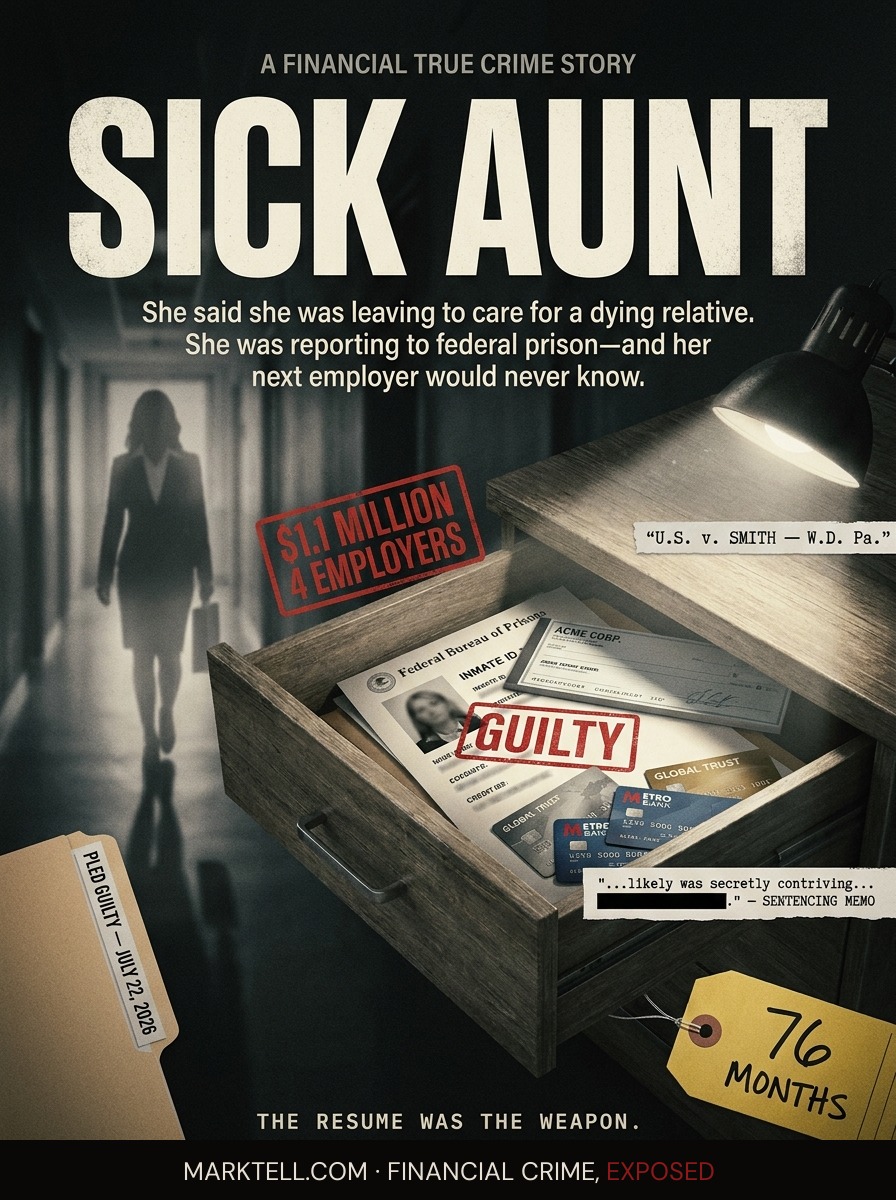
She told them she was caring for a sick aunt. She was reporting to federal prison.
Tracey Smith, 58, of Clairton, pleaded guilty this week to bank fraud in a scheme that ran across four employers and survived a federal prison sentence in the middle of it. The machine was her resume.
Ellen was fifty-four the summer the new controller arrived. She had been at the engineering firm for eleven years, long enough to know which invoices to flag and which vendors were slow payers and which of the partners preferred a physical check and which took ACH. She was the office manager. She was the one who ran the reimbursement queue.
The new controller's name was Tracey Smith. She came in the door in June 2022 with a resume that read clean. CFO experience. Controller experience. Payroll authority. The kind of person a mid-sized engineering firm looks at and thinks, finally, an adult who can own the books.
Ellen liked her. Tracey was warm in the hallway. Remembered names. Asked about Ellen's daughter's community college classes. Signed the reimbursement checks when Ellen slid them across the desk on Thursday afternoons.
One of those checks, in the summer of 2022, was for $2,400. The receipts, Tracey said, were in the drawer.
Ellen did not open the drawer.
Read that slowly. That is the whole story. A woman with the authority to sign her own reimbursements said the receipts were in the drawer, and the person who processed the check did not open the drawer, because why would she. The controller said the receipts were in the drawer.
According to the U.S. Attorney's Office for the Western District of Pennsylvania, Tracey Smith, 58, of Clairton, used two company credit cards at the engineering firm for $51,520 in personal expenses and reimbursed herself for $188,123 in expenses that were not company expenses. That is one job. That is one of four.
II. The resume.
Here is what the engineering firm did not know when they hired her.
In 2020, two years before Tracey walked into their office, she had already pleaded guilty in federal court to two counts of wire fraud. Wire fraud is the federal charge that covers moving stolen money through electronic systems, which is what happens when you take an employer's funds through payroll or bank transfer or credit card. She had defrauded two prior employers. She had been sentenced to fifteen months in federal prison and ordered to pay $113,000 in restitution.
She had not gone yet.
Federal sentences do not always begin the day the judge speaks. There is a report date. There is a window. In that window, Tracey Smith applied for and accepted a job as controller at the engineering firm. She sat across from the people who would hire her and did not mention the conviction. She took the payroll password.
In April 2023, ten months into the job, she told her employer she needed to leave to care for her "sick aunt."
That is the exact quote in the record. Sick aunt.
She reported to the Federal Bureau of Prisons.
She served her sentence for the previous fraud while the engineering firm processed her departure and looked for a replacement and told each other, in the hallway, that they hoped Tracey's aunt would pull through.
III. The second door.
She was released in February 2024. According to the reporting from TribLIVE.com and the government's sentencing memorandum, within a few months of walking out of federal custody she was hired by another Pittsburgh area company as a financial controller. Complete autonomy over financial systems. That was the phrase in the record.
Complete autonomy.
Picture the interview. A woman who has just finished a fifteen-month federal sentence for wire fraud sits across the desk from a small-company owner who needs someone to run the books. She is polished. She is fifty-six. She uses words like segregation and reconciliation and controls. She is hired.
The machine here is not sophisticated. It is not a Ponzi. It is not a token. It is not a boiler room.
It is a resume.
The resume is the machine. The credential that opens the door. The title that grants the password. The past employer that never called the next one, because the past employer was too embarrassed, or too busy, or had signed a separation agreement that said they would only confirm dates. That is how she kept getting hired. That is how the same person defrauded four companies across roughly six years while a federal case was pending against her.
The government's sentencing memorandum, filed in the Western District of Pennsylvania, described what Smith "likely was secretly contriving" during each hire: how quickly she could manipulate management into granting her access to company financial accounts, which she then used to pay down debts and cover personal expenditures. Utilities. Travel. Tuition. Mortgage payments. Car loans.
That is not a fraudster fantasy. That is a household budget.
She was not stealing to buy a yacht. She was stealing to pay the mortgage.
IV. The number.
$1.1 million. Combined. Across four employers. That is what she pleaded to on Tuesday, July 22, 2026, in federal court in Pittsburgh. Four counts of bank fraud. Bank fraud is the federal charge when you use deception to obtain money or property from a financial institution or from accounts held at one, which is what employer accounts are.
The judge imposed 76 months. Six years and four months. Restitution ordered on the full $1.1M.
Do the math on the fifteen-month sentence she served the first time. She stole $113,000. She served fifteen months. She came out. She stole roughly a million more.
The first sentence was not a deterrent. It was a pause.
V. Ellen.
Ellen still works at the engineering firm. She still runs the reimbursement queue. She opens the drawer now. She opens every drawer.
The partners had to hire an outside forensic accountant. They had to answer questions from their insurance carrier about controls. They had to sit down with staff and explain what had happened, and the staff, some of whom had liked Tracey too, some of whom had asked about her aunt, sat in the conference room and did not know where to put their eyes.
That part may be the saddest. Not the money. The way the whole office had to relearn how to trust the person signing the check.
Ellen is not in the court record. Ellen is a composite of the people who sat in that conference room and the people who sat in three other conference rooms at three other companies over roughly six years. The engineering firm is real. The controller was real. The check she signed with the receipts supposedly in the drawer, or one just like it, is in the record now as evidence.
VI. The machine keeps a resume.
Read the sentencing memorandum from the U.S. Attorney's Office and you will find the phrase manipulate management. It is the government's language for what she did in every interview. It is also what makes this case worth writing about for anyone who is about to hire a controller, a CFO, a bookkeeper, a treasurer, or anyone who will hold the password.
Not the exciting questions. Not the television questions. The ugly ones.
Did you call the last employer, or did you call the number on the resume.
Did you run a federal criminal records check, or did you run the cheap one that only pulls the county she listed.
Did you check PACER, the public federal court docket, for the applicant's name.
Did you ask why she left the last job.
Did you ask why she needs to leave this one to care for a sick aunt.
The machine is not a boiler room this time. It is a chair behind a desk with a nameplate. The predator did not cold-call anyone. She walked in through the front door because the door was open.
She thought she was a controller.
She was the fraud.
- TribLIVE.com | July 22, 2026 | "Clairton woman sent to prison for embezzling $1.1M from former employers"
- U.S. Attorney's Office, Western District of Pennsylvania | July 2026 | Sentencing memorandum, United States v. Tracey Smith
- U.S. District Court, Western District of Pennsylvania | 2020 | Guilty plea, two counts of wire fraud, United States v. Tracey Smith
- U.S. District Court, Western District of Pennsylvania | July 22, 2026 | Guilty plea, four counts of bank fraud, United States v. Tracey Smith
- Federal Bureau of Prisons | April 2023 to February 2024 | Custody records referenced in sentencing memorandum
Editorial Notice
MarkTell is a true crime publication about financial fraud. Some scenes, dialogue, and sequential details are reconstructed from court filings, enforcement actions, news reports, and public records. Where the public record does not provide exact details, editorial reconstruction is used to convey the documented pattern of events. Names of private individuals may be changed to protect identity. All factual claims are sourced to public documents cited in the Evidence Trail above. MarkTell does not provide investment, legal, or financial advice. Nothing published here constitutes a recommendation to buy, sell, or avoid any investment. Allegations described in active cases have not been adjudicated and defendants are presumed innocent until proven guilty. Readers should conduct their own due diligence before making financial decisions.