Seven arrests later, the pensioner's fourteen million is still gone
A pensioner in her seventies was drained of R14 million (about $780K USD) by a romance scam crew operating out of Cape Town between 2017 and 2018. Eight years later, the Hawks are still making arrests. The money is still gone.
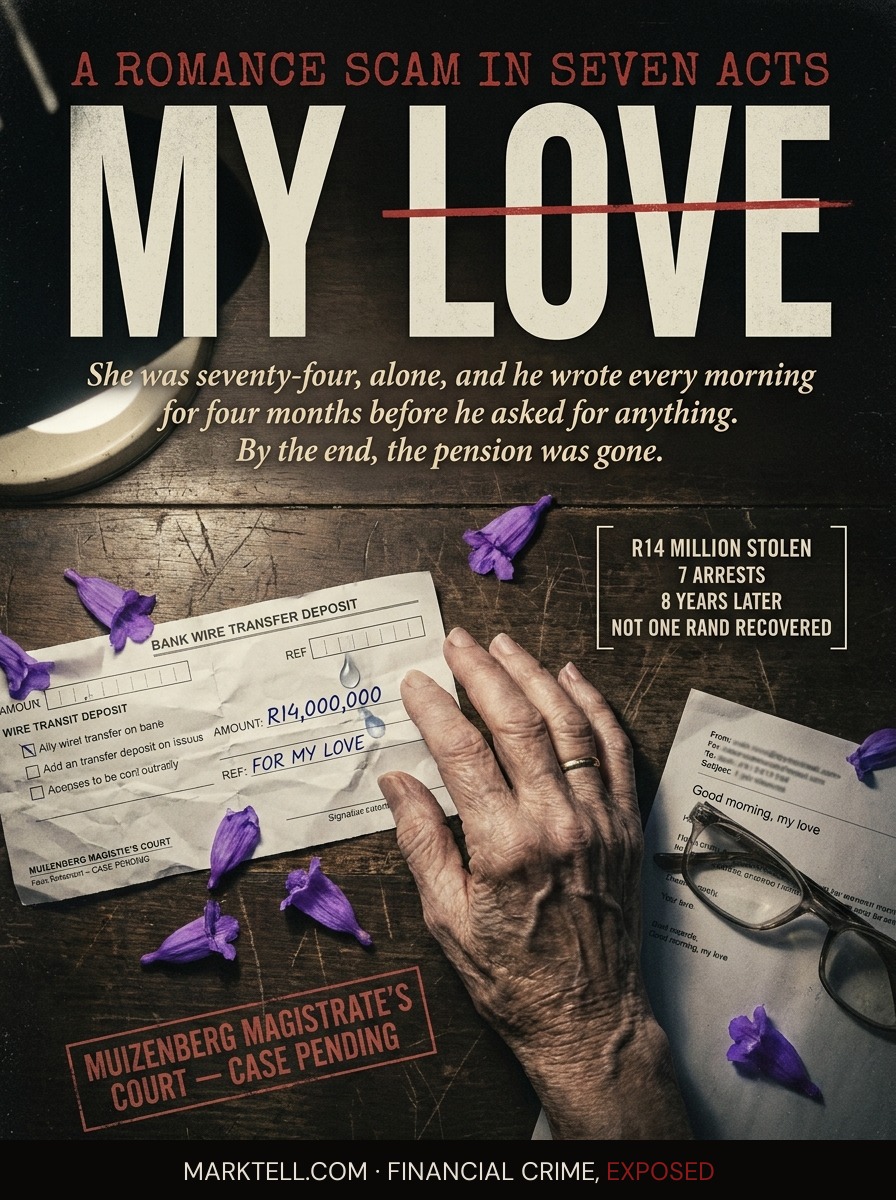
Margaret was seventy-four the year she started writing to David.
She lived alone in a small house in the Western Cape, in one of those suburbs where the jacarandas drop purple all over the driveway in October and nobody comes to sweep them but her. Her husband had been gone six years. Her son was in Perth. The grandchildren sent voice notes on birthdays. She kept the house tidy because tidy was a habit her mother had given her, and she kept the pension in a savings account because her husband had said, before he died, that the pension was not to be touched unless the roof came off.
The roof was fine. The pension was fine. Margaret was the one who was not fine, and she did not know it.
David wrote to her first in the autumn of 2017. She was not sure, later, how they had found each other. A dating site. A widow's forum. One of those places she had clicked into on an evening when the house was very quiet and the television was showing a program she had already seen. He said he was an engineer. He said he was working on an offshore rig somewhere off the coast of West Africa. He said his wife had died of cancer four years earlier and he had a daughter at boarding school in England.
He wrote every morning. Good morning, my love. He wrote in the evening. How was your day, my love. He asked about her garden. He asked about her son. He remembered the grandchildren's names. For four months, he asked her for nothing.
That is the part the reader needs to hold onto. Four months of nothing.
Then the emergencies started.
I.
The Hawks announced this week that two more suspects had been arrested in connection with the fraud that took R14 million (about $780K USD) from an elderly pensioner in the Western Cape between 2017 and 2018. That brings the total to seven. The seven are expected in the Muizenberg Magistrate's Court on Monday, July 29.
The named suspects so far are Asanda Dwesini, thirty-nine. Nomphelo Fetman, thirty-two. Shan Gabrelle Lewis, forty-seven. Lavina Oppel. Brazil Astor Hendricks. Two more unnamed as of this writing. The charges are fraud and money laundering. Two of the earlier arrestees were released on R4,000 bail (about $220 USD) in March. The others remained in custody pending a bail application.
The Bellville Serious Commercial Crime team is running the case, working with the National Intervention Unit. The Hawks spokesperson, Zinzi Hani, has told the press what the police always tell the press in these cases. Trust your gut. Be wary of rushed payments. Be wary of panic.
That is the correct advice. It is also, in Margaret's case, eight years too late.
II.
The romance scam is not a con. It is a production.
A con is one man with a story. A production has a cast. It has a script. It has a back office. Somebody wrote the messages David sent Margaret. Somebody chose the photograph of the man on the rig, probably lifted from an oil company's website or a stock image database or a real engineer's Facebook page. Somebody opened the bank accounts that received her money. Somebody moved the money out of those accounts as fast as it came in. Somebody kept the books.
According to the Hawks, seven people are now charged in the handling of Margaret's fourteen million. Seven people. For one victim.
That is the shape of the machine. The person on the screen typing "my love" is one role. The person opening the mule accounts is another role. The person moving the money into cash or into crypto or into the next set of accounts is another role. The person keeping the operation from being traced back to any single face is another role. The face on the screen is the least important part. The face is disposable. The accounts are the product.
South Africans lost R125 million (about $7M USD) to online romance scams in 2022 alone, according to reporting from the South African Banking Risk Information Centre. That is not a rounding error. That is an industry.
III.
The first emergency was small.
David wrote to Margaret in the winter of 2018. He had been trying to fly home to meet her. He had been talking about it for weeks. He wanted to see the garden she had described. He wanted to meet her son when her son came from Perth. He had booked the flight. The flight had been cancelled. He needed to pay a fee to reroute. It was a few thousand rand. Would she, could she, just this once.
She sent it.
He paid her back the next week. She saw the transfer come in. That was the hook. That was the part of the machine that made the rest of the machine possible.
Then the emergencies got larger.
A fine at a port. A frozen account he could not access from the rig. A medical bill for his daughter. A lawyer he needed to retain for a contract dispute. A tax matter. A customs matter. A shipment of engineering equipment held at a border. Each one urgent. Each one solvable. Each one with a wire number typed carefully into a bank slip at the counter of a branch Margaret had been going to for thirty years.
The tellers knew her by name. Nobody stopped her. There is no law against a seventy-four-year-old woman moving her own money.
By the end of 2018 the account was empty. She had moved R14 million. About $780K USD. Every rand her husband had told her not to touch unless the roof came off.
The roof was still fine. She was the one who had come off.
IV.
The moment she realized was not dramatic.
Read that slowly. It was not a phone call from a bank. It was not a knock at the door. It was David not writing back one morning. And then not writing back the next morning. And then a week going by. And then two.
She checked her sent folder. She read the messages back. She read the ones where he had called her my love and the ones where he had asked her about the jacarandas and the ones where he had said, just this last time, I will pay you back as soon as the contract clears.
The contract was not going to clear. There was no contract. There was no rig. There was no daughter at boarding school in England. There was a photograph she had never verified and a name she had never checked and a story she had wanted to be true because the house was very quiet and the television was showing a program she had already seen.
That part may be the saddest.
V.
The Hawks did not come to Margaret in 2018. They came in 2026.
Eight years. That is how long it took to trace the accounts, to identify the mules, to build a case that could bring seven people into the Muizenberg Magistrate's Court. The first three arrests happened in March 2026. Two more later that month. Two more this past week. According to the Directorate for Priority Crime Investigation, the suspects face charges of fraud and money laundering. None have been convicted. Allegation is not adjudication.
But the money is not coming back. It has not been coming back for eight years. In cases like this it almost never does. The accounts where it landed have been closed. The cash withdrawn. The crypto, if there was crypto, tumbled through mixers and off into wallets nobody can subpoena. Even if all seven are convicted and sentenced tomorrow, Margaret's R14 million (about $780K USD) is not sitting in an evidence locker waiting for her to sign for it.
That is the ugly question the family members of every romance-scam victim eventually ask. Not whether the police will catch them. Not whether the courts will convict them. The ugly question is whether the money is anywhere it can still be reached. Almost always the answer is no.
VI.
If you are reading this because you are worried about someone, here is what to know.
The romance scam does not look like a scam. It looks like a relationship. It moves at the pace of a relationship. It waits, the way a relationship waits. Four months of nothing is not a bug in the machine. It is the machine working.
The tells are not in what the person on the screen says about themselves. The tells are in the shape of the story. Always overseas. Always unable to meet. Always one emergency away from coming home. Always a bank problem, a customs problem, a legal problem, a medical problem. Always urgent. Always solvable if you just send this one more transfer.
If someone you love is sending money to a person they have never met in a place they cannot verify to solve a problem that keeps changing shape, the machine has already started. It does not stop on its own. It stops when the account is empty or when someone outside the loop pulls the plug.
Margaret is a composite. She stands for a real woman in the Western Cape who is not being named. But there are Margarets in every province and every country and every dating site, and there are seven-person crews working every one of them.
The Hawks caught this crew. Or say they did. That case will move through the Muizenberg court on Monday and through the appeals for years after. Somebody will go to prison. Somebody will not. The machine that ran this operation is not seven people. Those seven were the hands. The machine is the script, the accounts, the pipeline, the pattern. The machine is still running.
Somewhere tonight a woman is opening a message that says good morning, my love.
She is smiling at her screen.
She has not sent anything yet.
- News24 | July 26, 2026 | "Two more suspects arrested in R14m romance scam that fleeced elderly pensioner"
- Directorate for Priority Crime Investigation (Hawks) | March 19, 2026 | Public statement on initial arrests
- Muizenberg Magistrate's Court | March 2026 and July 2026 | Court appearance records
- South African Banking Risk Information Centre (SABRIC) | 2023 | Annual fraud statistics reporting R125M in romance scam losses for 2022
- BankservAfrica Fraud Intelligence Conference | February 2025 | Industry commentary on romance scam growth
Editorial Notice
MarkTell is a true crime publication about financial fraud. Some scenes, dialogue, and sequential details are reconstructed from court filings, enforcement actions, news reports, and public records. Where the public record does not provide exact details, editorial reconstruction is used to convey the documented pattern of events. Names of private individuals may be changed to protect identity. All factual claims are sourced to public documents cited in the Evidence Trail above. MarkTell does not provide investment, legal, or financial advice. Nothing published here constitutes a recommendation to buy, sell, or avoid any investment. Allegations described in active cases have not been adjudicated and defendants are presumed innocent until proven guilty. Readers should conduct their own due diligence before making financial decisions.