Mosaic said it managed tens of millions. The real number was under seven hundred thousand.
A Pennsylvania-registered crypto trading shop run out of Miami sold itself as a Binance and BitMEX-tied trading desk earning up to 60% a month. The CFTC says it was a virtual house of cards, and a Florida federal judge made the collapse final.
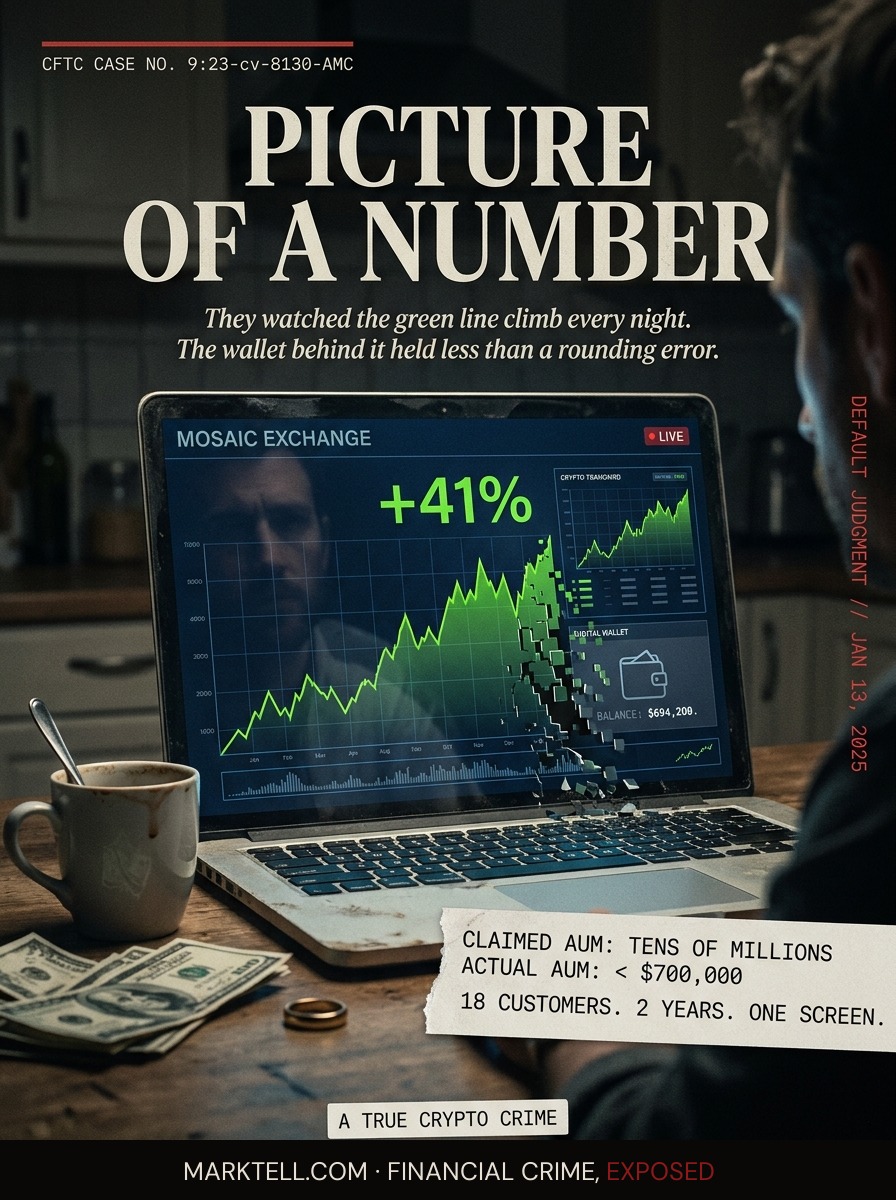
The screen says he is up forty-one percent for the month.
It is a Tuesday in early 2021. The man, call him a customer because that is the word the court will use, is sitting at a kitchen table in a small house outside Philadelphia. The laptop is open. The Mosaic Exchange dashboard is glowing back at him in the dark blue palette every crypto site uses, the one that is supposed to look like a Bloomberg terminal if you have never seen a Bloomberg terminal. There is a green number at the top. There is a chart underneath it that goes up and to the right.
He refreshes it. The number goes up.
He does not know yet that the number is a picture of a number. He does not know that the wallet behind the picture holds less than seven hundred thousand dollars in total customer deposits, against a story Mosaic has been telling for two years about tens of millions under management. He does not know that the trades the dashboard is showing him as winners are, in the actual record the CFTC will later assemble, losers. He does not know that some of his deposit has already left the system in a way no trading platform should ever let a deposit leave. It went to dinner. It went to travel. It went to the personal life of a man named Sean Michael in Miami.
He just sees green. He shows his wife. They talk about whether to add more.
I.
Mosaic Exchange Ltd. registered in Pennsylvania and operated, by the time the federal complaint landed, out of Florida. Its CEO was Sean Michael. Its pitch, according to the September 26, 2023 complaint filed by the U.S. Commodity Futures Trading Commission, was a familiar one if you have spent any time inside a crypto Discord. Mosaic said it ran an algorithmic trading desk that turned customer deposits into monthly returns of "20% to 60%." In other materials it was "10% to over 50%." The accuracy of the trading system, the company claimed, was 82%.
Read those numbers slowly. A real, regulated commodity trading advisor that posted a steady twenty percent a month would, inside of a year, be the most famous fund manager alive. Twenty percent monthly compounded is roughly a nine-fold return per year. Sixty percent monthly is a number the math refuses to take seriously. You do not need to know what a derivative is to know that a desk earning that does not need your seventy-five hundred dollars.
Mosaic also said it had partnerships with Binance and BitMEX, the two largest crypto derivatives venues in the world at the time. It did not. The CFTC complaint was specific about that. The partnerships were invented.
This is the part the dashboard was hiding.
II.
A digital asset commodity scheme, in plain terms, is what it sounds like. A platform takes customer money, claims to trade crypto for them, and either trades badly, does not trade at all, or treats the deposits as the operator's checking account. The CFTC has jurisdiction over this because Bitcoin and several other major digital assets are commodities under the Commodity Exchange Act, the federal law that governs futures and other derivatives markets. When somebody solicits people to put money into a crypto trading product and lies about it, that is the agency's lane.
Between February 2019 and June 2021, according to the complaint, Mosaic ran in that lane. At least eighteen people put money in. Some were in the United States. Some were not. The complaint puts the actual assets under management, at peak, at less than $700,000. That is the wallet. The story Mosaic told publicly was that the wallet was tens of millions.
The gap between those two numbers is the entire fraud. Everything else is decoration.
III.
CFTC Commissioner Kristin Johnson, when the complaint was filed, called the operation "a virtual house of cards." She said it was a sham. The phrase was deliberate. A house of cards stands as long as nobody touches it and nobody asks where the load is bearing. The Mosaic dashboard worked the same way. It rendered a clean, upward chart. It did not render the underlying wallet. It did not render the personal expenses. It did not render the actual trade history.
The customers were not stupid. They were looking at the part they were given to look at. The part they were given to look at had been engineered to be looked at.
I have built dashboards. I have audited them for other people. The thing nobody outside the industry quite understands is how easy it is to make a screen show whatever you want it to show. The screen is not the truth. The screen is marketing. The truth is in the wallet addresses and the bank records, and customers almost never see those.
That part may be the saddest. They were trusting the wrong artifact.
IV.
On January 13, 2025, the U.S. District Court for the Southern District of Florida entered final default judgments against Mosaic Exchange Ltd. and Sean Michael. Default judgment means the defendants did not meaningfully fight the case. The court accepted the CFTC's allegations as established and moved to remedy.
The remedy, as ordered, totaled more than $1.1 million.
$468,600 in restitution to defrauded customers.
$60,980 in disgorgement, the legal term for clawing back ill-gotten gains.
$660,000 as a civil monetary penalty.
Both Mosaic and Sean Michael were permanently barred from registering with the CFTC and from trading in any CFTC-regulated market. The case number, for anyone who wants to read the docket themselves, is 9:23-cv-8130-AMC.
A judgment is a piece of paper. Whether the eighteen customers actually see the $468,600 depends on whether there is anything left to collect from. Default judgments against operators of small-scale crypto fraud are often, in practice, gravestones. They mark the spot. They do not always pay for the burial.
V.
Look at the shape of this one. It is small. Under a million in real money. Eighteen customers. A two-year run. A CEO operating out of Miami who, when the federal government finally arrived, did not even file an answer.
This is the size most crypto fraud actually is. Not FTX. Not Celsius. The headline cases are the ones that hit the newspaper because the numbers are too big to ignore. The Mosaics are the ones that move quietly, eighteen customers at a time, and never make it past page eleven of a CoinMarketCap aggregator.
The pattern, though, is identical at every scale. A polished website. A trading dashboard that shows winners. Claimed partnerships with the biggest names in the industry, designed to borrow legitimacy without asking permission. Returns that any trader on earth would tell you are not possible to sustain. An operator who, when the deposits start coming in, treats the operating account like his own.
If you have been pitched something that sounds like Mosaic this year, under a different name, with a different dashboard, do this. Do not look at the chart. Look at three things. Look up whether the firm is registered with the CFTC or the National Futures Association. The NFA database is free and public. Ask the operator for a wallet address you can verify on-chain that holds the assets they claim. A real desk can show you. A real desk wants to show you. Ask which exchange they actually clear through, by name, and then ask that exchange. Binance and BitMEX both have public processes for confirming or denying institutional partnerships. Mosaic did not survive that question. Most of them do not.
VI.
The customer at the kitchen table, the composite, the one watching the green number go up. He did not know what he did not know. He did not know that the dashboard and the wallet were two different objects. He thought they were the same object.
That is the trick. That has always been the trick.
He thought he was watching his money grow.
He was watching a screen.
- U.S. Commodity Futures Trading Commission | September 26, 2023 | Complaint, CFTC v. Mosaic Exchange Ltd. and Sean Michael, Case No. 9:23-cv-8130-AMC, S.D. Fla.
- U.S. District Court for the Southern District of Florida | January 13, 2025 | Final Default Judgment, Case No. 9:23-cv-8130-AMC
- CFTC Press Release | September 26, 2023 | Statement of Commissioner Kristin Johnson on Mosaic Exchange
- CoinMarketCap / GN: CFTC Enforcement | 2025 | "CFTC Charges Crypto Trading Platform Mosaic for Fraud"
- National Futures Association | public registration database | nfa.futures.org/basicnet
Editorial Notice
MarkTell is a true crime publication about financial fraud. Some scenes, dialogue, and sequential details are reconstructed from court filings, enforcement actions, news reports, and public records. Where the public record does not provide exact details, editorial reconstruction is used to convey the documented pattern of events. Names of private individuals may be changed to protect identity. All factual claims are sourced to public documents cited in the Evidence Trail above. MarkTell does not provide investment, legal, or financial advice. Nothing published here constitutes a recommendation to buy, sell, or avoid any investment. Allegations described in active cases have not been adjudicated and defendants are presumed innocent until proven guilty. Readers should conduct their own due diligence before making financial decisions.