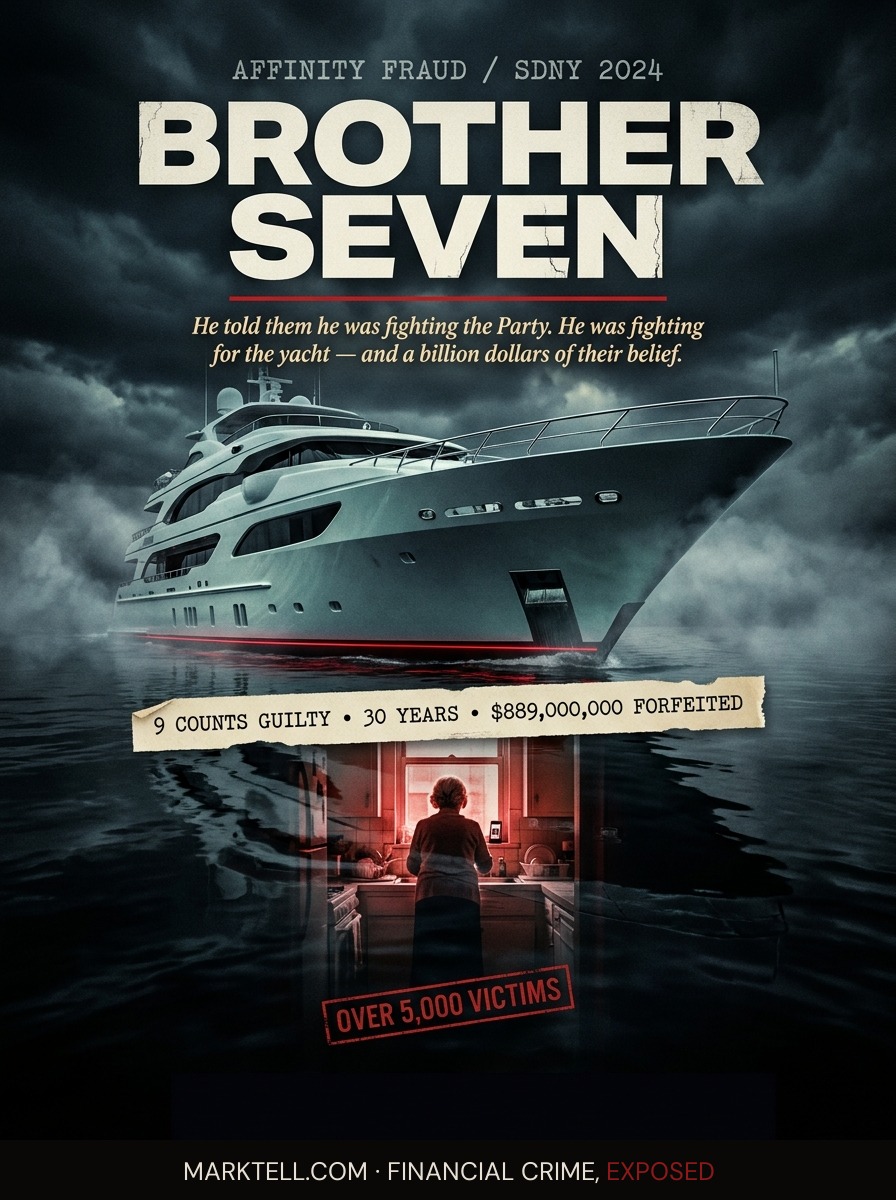
He said he was fighting the Party. He was fighting for the yacht.
Miles Guo built a movement, a media empire, and a coin. Prosecutors say he built them on the savings of Chinese immigrants who thought they were funding a revolution. On June 29, a federal judge sent him away for thirty years. His fans still came.
Mei was 58 the night she wired the last of it.
Her kitchen in Flushing was quiet at that hour. The building's radiators ticked. Her shift at the home health agency had ended at nine, and she had eaten cold rice standing at the counter because she wanted to catch the livestream before the good part. On the counter next to the rice bowl was a printed sheet with routing numbers and a memo line. On her phone, propped against the sugar jar, Miles Guo was talking. He was always talking. He wore a dark suit and sat in front of a bookshelf, and he spoke Mandarin the way a man speaks when he knows the room is listening.
He said the Party was afraid of him. He said the movement needed her.
She clicked confirm. The wire was $6,000. It was the third one she had sent that year. The first had bought her shares in something called GTV Media Group. The second had bought a G|CLUBS membership, which arrived in a heavy envelope with a gold-embossed card that she kept in the drawer where she used to keep her mother's letters. The third would go into a cryptocurrency he called H-Coin, launched on a platform he called the Himalaya Exchange.
She did not think of herself as an investor. She thought of herself as a patriot.
That distinction is the whole story.
I.
The man on the screen went by many names. Guo Wengui in the Chinese press. Ho Wan Kwok on his passport. Miles Kwok in the New York real estate world. Miles Guo on the broadcasts. His followers called him Brother Seven. His inner circle called him The Principal. His financial paperwork sometimes called him Boss.
He was a real estate developer in Beijing before he fled China in 2014, one step ahead of an anti-corruption sweep that would have swallowed him. He applied for asylum in the United States in 2017. He set up in a penthouse on Central Park South and began broadcasting.
The broadcasts were the product. Everything else was built on top of them.
He told his audience, mostly Chinese immigrants scattered across the diaspora, that he was going to bring down the Chinese Communist Party. He said the Party had murdered his brother, stolen his fortune, and hunted his family. Some of that was true. Enough of it was true that the rest could ride along.
He built a media company. He built a farm alliance called the Himalaya Farm Alliance, chapters in dozens of cities where followers could gather and organize and, when the moment came, invest. He partnered with Steve Bannon, who was arrested on Guo's 152-foot yacht in 2020 on unrelated charges.
The yacht was called the Lady May. Remember the yacht.
II.
Federal prosecutors in the Southern District of New York laid it out in the indictment and again at trial. Between 2018 and 2023, Guo ran a set of offerings that pulled in more than a billion dollars from thousands of investors. The specific buckets, as charged:
$452 million from an unregistered stock offering in GTV Media Group.
$150 million from GTV loans.
$250 million from G|CLUBS memberships, pitched as an exclusive luxury club.
$262 million from H-Coin and the Himalaya Exchange, pitched as a cryptocurrency backed by a basket of currencies and gold.
Add them up. That is over a billion dollars in four years, raised almost entirely from people who believed they were funding a revolution.
The SEC got there first. In 2021, GTV Media Group, Saraca Media Group, and Voice of Guo Media settled with the Commission and agreed to repay more than $480 million to over 5,000 investors, plus $35 million in fines, for illegal fundraising conducted in just three months in the spring of 2020. The SEC action was civil. It did not stop him. It became a footnote in the next pitch.
The criminal case came in March 2023. The FBI raided the penthouse on Central Park South. A fire broke out in the unit during the raid. Guo was arrested. He was charged with twelve counts. He went to trial in the summer of 2024.
The trial lasted seven weeks. On July 16, 2024, the jury convicted him on nine counts. Securities fraud. Wire fraud. Bank fraud. Racketeering conspiracy. Money laundering.
Sentencing was set for later. Sentencing came on June 29, 2026.
III.
The money did not go where he said it went.
Prosecutors traced it through shell entities and family accounts and into things you can photograph. A 50,000-square-foot mansion in New Jersey. A $1 million Lamborghini. The Lady May, valued at $37 million. The Central Park South penthouse. A red Bugatti for a family member. Rugs. Watches. A fireplace that reportedly cost more than most of the wires his followers sent him.
Judge Analisa Torres, at sentencing, said he had preyed on people seeking to bring democracy to China. She said he had dedicated himself to increasing his own wealth. She ordered him to forfeit $889 million.
The sentence was thirty years.
His former chief of staff, Yvette Wang, was already serving ten years for her role. His longtime financial advisor, Kin Ming Je, known as William Je, was charged in the same indictment but has not been arrested or tried. He is believed to be overseas.
IV.
Mei found out the way most of them found out. Slowly, then all at once.
The GTV shares she bought in the spring of 2020 never traded on any exchange she could reach. When she asked the local Himalaya Farm chapter about them, she was told the shares would be worth ten times their price when the movement took power in Beijing. The G|CLUBS membership entitled her to luxury services she never used, because she worked twelve-hour shifts and did not need a concierge. The H-Coin sat in an account on the Himalaya Exchange that eventually stopped loading on her phone.
The broadcasts continued for a while after his arrest. Someone else read the statements. Then those stopped too.
She did not tell her son. She did not tell her sister in Guangzhou. She kept the gold-embossed G|CLUBS card in the drawer with her mother's letters because throwing it away would have meant admitting something she was not ready to admit.
She had not been stupid. She had been recruited.
That is what affinity fraud is. It is not a pitch to strangers. It is a pitch inside a community. The pitcher speaks your language. He shares your grievances. He names your enemy. He gives you a way to fight back that costs money. The money is the fight.
Guo did not sell stocks to Mei. He sold her the feeling of being on the right side of history. The stocks were the receipt.
V.
On the morning of the sentencing, hundreds of his supporters filled the plaza outside the federal courthouse in Lower Manhattan. They held flags. They chanted his name. Some of them had lost money. Some of them had lost a lot of money. They came anyway.
This is the part that is hard to write without editorializing, so I will just describe it.
A man is convicted of stealing over a billion dollars from thousands of people, many of them immigrants who worked shifts like Mei's to save what he took. He is sentenced to thirty years. And a crowd of those same people, or people like them, stands outside the courthouse and defends him.
The prosecutor, Ryan Finkel, said it plainly during the case. Guo is not a democratic activist. He is a con artist, a scammer, and a thief.
But the con did not end at conviction. The con was the identity he sold them. Taking that away is harder than taking away thirty years of his life.
Some of them will believe, for the rest of their lives, that he was framed by the Party. That the trial was a Party operation. That the yacht and the mansion and the Lamborghini were props planted by enemies. Belief is the last thing to go, and for some of them it will not go at all.
That may be the saddest part.
VI.
Mei watched the sentencing coverage on her phone at the kitchen table where she had wired the money. She did not go to the courthouse. She did not chant. She did not weep.
She got up. She washed the rice bowl. She put the phone face down on the counter.
The G|CLUBS card is still in the drawer. She has not decided what to do with it.
The machine that took her money has a name now. Federal Bureau of Prisons register number, thirty-year sentence, $889 million forfeiture order. It has a case caption and a docket. It has an ending.
The machine that took her belief does not have an ending. It has a next operator. Somewhere, right now, a man is on a livestream, speaking a language his audience misses, naming an enemy they already fear, and asking for a wire.
He is not selling stock. He is selling the fight.
The stock is just the receipt.
- U.S. Department of Justice, Southern District of New York | June 29, 2026 | Sentencing announcement, United States v. Ho Wan Kwok
- U.S. District Court, Southern District of New York | July 16, 2024 | Jury verdict, United States v. Ho Wan Kwok et al.
- U.S. Securities and Exchange Commission | September 13, 2021 | Settlement with GTV Media Group, Saraca Media Group, Voice of Guo Media
- New York Post | June 30, 2026 | "Chinese NYC scammer learns fate for 'stunning' $1.3B fraud"
- U.S. Attorney's Office SDNY | March 15, 2023 | Indictment and arrest announcement, Ho Wan Kwok
- Reuters, AP, Bloomberg coverage of sentencing | June 29-30, 2026
- Sentencing of co-defendant Yvette Wang | 2025 | SDNY docket
Editorial Notice
MarkTell is a true crime publication about financial fraud. Some scenes, dialogue, and sequential details are reconstructed from court filings, enforcement actions, news reports, and public records. Where the public record does not provide exact details, editorial reconstruction is used to convey the documented pattern of events. Names of private individuals may be changed to protect identity. All factual claims are sourced to public documents cited in the Evidence Trail above. MarkTell does not provide investment, legal, or financial advice. Nothing published here constitutes a recommendation to buy, sell, or avoid any investment. Allegations described in active cases have not been adjudicated and defendants are presumed innocent until proven guilty. Readers should conduct their own due diligence before making financial decisions.