Eight companies, one name, and the pipe that kept the money moving
Federal prosecutors allege Benjamin Paul Wiener built eight companies to move roughly $20 million from dozens of investors through a loop that looked like returns and worked like a pump. This is what the pipe looked like from the chair of someone who wired in.
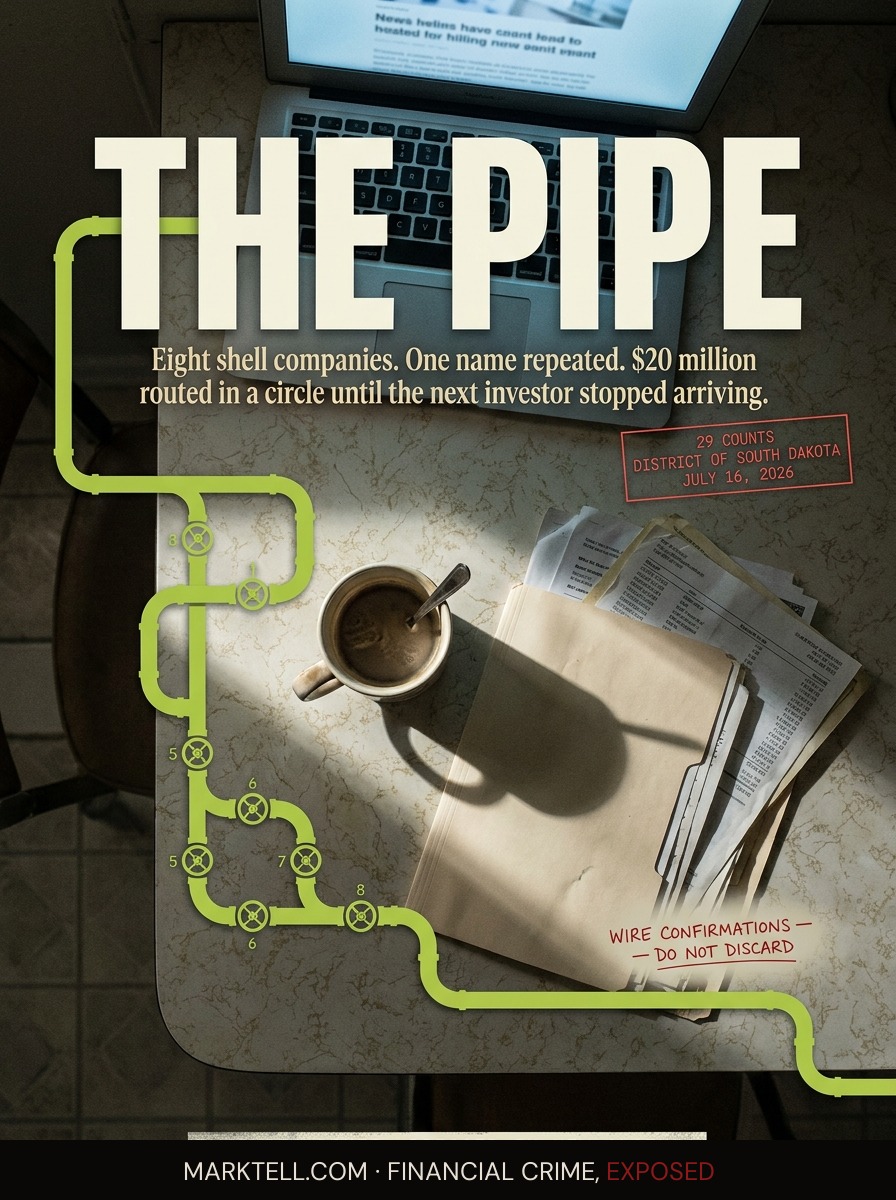
Dale was 62 and semi-retired from a farm equipment dealership outside Sioux Falls. He had turned the spare bedroom into an office when the grandkids stopped visiting as often. A desk. A laptop. A filing cabinet with a drawer for taxes and a drawer for what he called the crypto stuff.
On a Tuesday morning in the summer before the indictment, Dale sat at the kitchen counter with a coffee going cold and opened the quarterly update on his laptop. The number on the screen was up. Not a lot. Enough. The kind of steady climb a man his age is told to want. Fixed income, they had called it. Digital fixed income. He liked the sound of both words together. Digital was the future. Fixed was the past. Between them, he thought, was a place he could sit.
He had wired the first tranche the year before. He had wired the second one because the first one worked. That is how the pipe fills.
I have watched this pattern from both sides. I have written smart contracts. I have audited them. I have also sat in the Discord at 2 a.m. and told strangers the code was clean while the men with the keys were already loading the truck. So when I read the indictment out of the District of South Dakota, I recognized the shape of the thing before I read the counts.
Federal prosecutors indicted Benjamin Paul Wiener on 29 counts. Wire fraud. Money laundering. Bank fraud. Aggravated identity theft. According to the Justice Department announcement on July 16, 2026, Wiener allegedly raised approximately $20 million from dozens of investors and used new investor money to pay earlier investors. That mechanic has a name older than any blockchain. It is a Ponzi. The crypto part is decoration. The pipe is the crime.
Wiener pleaded not guilty on July 10, 2026, before U.S. Magistrate Judge Veronica L. Duffy. He was released on bond. Trial is scheduled for September 15, 2026. Nothing here is adjudicated. Everything here is alleged. Hold that line in your head while I walk you through the pipe.
I.
The pipe had eight valves. That is the number of companies named in the indictment.
Benaiah Capital LLC.
Benaiah Holdings, Inc.
Benaiah Digital Fixed Income LP.
Benaiah Digital LP.
Benaiah Management Company, Inc.
Benaiah Enterprises, LLC.
Aslan Management, LLC.
Runway Four10.
Read that list slowly. The same root word repeats. Benaiah, Benaiah, Benaiah. Then two names that do not match. Aslan. Runway Four10. If you have ever seen a family tree drawn by someone who did not want anyone to follow it, that is what this looks like on paper. Companies inside companies. Management entities that manage other entities. A limited partnership that sounds like a bond fund. A holding company. An enterprise. Words that were built to look like a business.
Here is what those words do, mechanically. Each entity can hold a bank account. Each account can receive a wire. Each account can send a wire. Money moves from Dale's bank to Benaiah Capital LLC, then to Benaiah Digital LP, then to a crypto exchange account in the name of Benaiah Management, then back out to Benaiah Holdings, and the ledger, if a regulator ever asks, looks like eight companies doing business. It is one man moving one pile of money in a circle. The circle is the trick.
Prosecutors put it in cleaner language. They allege the funds were moved through financial institutions and cryptocurrency exchanges to conceal their location, source, ownership, and control. That is the DOJ describing the pipe. I am just naming the valves.
II.
Dale did not see the pipe. Dale saw a website and a quarterly update.
That is not stupid. That is what the pipe is for. A retail investor sitting at a kitchen counter cannot audit eight LLCs. He is not supposed to. He is supposed to see the front of the store. The front of the store is the pitch. The back of the store is where the boxes get unpacked and repacked and shipped somewhere else with a new label.
The pitch, according to the indictment, involved materially false statements about how the money would be used and what it was earning. This is standard language in a wire fraud count. It means, in plain English, that prosecutors say Wiener told investors one thing and did another.
What Dale saw on his screen was a number that went up. What the indictment alleges was happening behind the number was that the money to pay Dale's imaginary returns was coming from the next Dale. And the next one. And the next one. Every Ponzi needs a next one. When the next one stops arriving, the pipe runs dry, and everyone downstream finds out at the same time.
III.
I want to be careful here, because I have been on the inside of protocols that failed for reasons that were not fraud. Code has bugs. Markets crash. Founders make bad calls. Not every collapse is a crime.
But there is a difference between a project that fails and a machine that was built to fail on a schedule. The tell is in the plumbing. If you find eight entities and the money is moving in a circle and the returns to old investors are traceable to deposits from new investors, you are not looking at a business that had a bad quarter. You are looking at a pipe.
The indictment alleges this pipe. A grand jury saw enough to return 29 counts. That is a serious document. It is also, still, an allegation. Wiener is entitled to his defense. The government has to prove what it has charged.
What I can tell you, as someone who has read too many of these, is that the shape is familiar. Multiple entities with overlapping names. A "digital" wrapper on an old-fashioned strategy. Cash movements through crypto exchanges used less for investment and more for laundering the trail. New investor money circulating fast enough to look like yield.
The crypto industry did not invent this. The crypto industry gave it a new set of clothes. The suit is the same suit. The tailor changed.
IV.
Come back to Dale. He is at the kitchen counter again. It is a different Tuesday. The coffee is fresh this time because he made it right before he sat down. His laptop is open to a news site. The headline mentions Sioux Falls and a $20 million indictment and a name he recognizes from every quarterly update he has ever opened.
He does not close the laptop. He reads it twice. Then he opens the filing cabinet and takes out the folder with the wire confirmations. He puts the folder on the counter next to the laptop. He does not touch it for a while.
That is the moment the pipe becomes visible from his chair. Not a phone call. Not a login that shows zeros. Just a name in a headline and a folder in a drawer, and the arithmetic of what it means that both exist on the same counter.
The indictment describes dozens of victims. The Justice Department has not, as of this writing, released a full accounting of who lost what. That work is still happening. Recoveries in cases like this are typically partial, sometimes minimal, and always slow. The lawyers get paid first. Then the receivers. What is left, if anything, gets divided among the people who wired in when the pipe was still filling.
V.
If you are reading this because you almost sent a wire to something that sounded like Benaiah Digital Fixed Income, or because you already did, here is what I would tell you as someone who has been the person in the Discord vouching for the code.
Look at how many entities are on the paperwork. If the answer is more than two, ask why. A legitimate fund has a manager and a fund. It does not need a holding company, a management company, an enterprise LLC, and two limited partnerships with the same root name. That structure is not for you. That structure is for the money.
Look at whether the returns are coming from an actual strategy you can describe in a sentence. "Digital fixed income" is not a strategy. It is a phrase. Ask what the money is doing. If the answer changes each time you ask, or if it involves words like "arbitrage" and "proprietary" and "algorithmic" without a document behind them, the phrase is doing the work the strategy is not.
Look at the wallet if there is one. On-chain, most things that claim to be earning yield are visible. If nothing is visible, the yield is not on-chain, which means it is somewhere you cannot audit, which means you are trusting a person, not a system. Decide whether you trust the person that much. Most of us should not.
VI.
Dale is not a real person. The Dales are real. The indictment describes them across South Dakota and Minnesota. The chair at the kitchen counter is real in dozens of houses. The folder in the filing cabinet is real. The number on the screen was real until it wasn't.
The pipe is what the government alleges. September will decide what a jury believes about it.
What I can tell you now, from where I sit, is that the machine has a shape and the shape repeats. Eight companies is a lot of companies for one man. New investor cash paying old investor returns is not a strategy. It is a countdown.
The pipe fills until it doesn't.
Then everyone downstream learns the same thing at the same time.
- U.S. Department of Justice press release | July 16, 2026 | Announcement of indictment of Benjamin Paul Wiener
- Federal grand jury indictment, District of South Dakota | 2026 | 29 counts including wire fraud, money laundering, bank fraud, aggravated identity theft
- Court record, U.S. District Court, District of South Dakota | July 10, 2026 | Not-guilty plea before Magistrate Judge Veronica L. Duffy; bond; trial set September 15, 2026
- CryptoSlate | July 20, 2026 | "Crypto investor charged with using 8 companies and new investor cash to keep an alleged $20M fraud alive"
Editorial Notice
MarkTell is a true crime publication about financial fraud. Some scenes, dialogue, and sequential details are reconstructed from court filings, enforcement actions, news reports, and public records. Where the public record does not provide exact details, editorial reconstruction is used to convey the documented pattern of events. Names of private individuals may be changed to protect identity. All factual claims are sourced to public documents cited in the Evidence Trail above. MarkTell does not provide investment, legal, or financial advice. Nothing published here constitutes a recommendation to buy, sell, or avoid any investment. Allegations described in active cases have not been adjudicated and defendants are presumed innocent until proven guilty. Readers should conduct their own due diligence before making financial decisions.